What types of sensors are used in precision agriculture?
In the face of population growth, climate change, less rainfall, and higher food demand, traditional farming is under strain. This pressure is driving a shift toward more advanced farming methods. To boost farm productivity and gather accurate data, modern precision farming tools, like sensors, are now essential.
Smart farm sensors offer clear benefits, like finding and tracking livestock. They help identify animals and monitor their health.
They can also detect heat stress. This lets farmers quickly isolate and treat sick cows. It also helps them manage herds better.
Additionally, these sensors help detect pests and allow timely action to protect crops from environmental threats. Farmers can also monitor their fields from far away and track crop yields. This helps them make better decisions and work more efficiently.
What are the types of sensors used in agriculture?
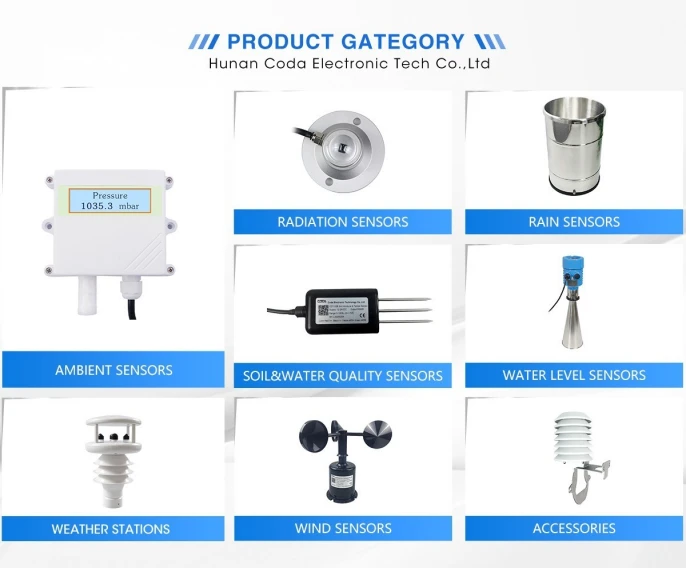
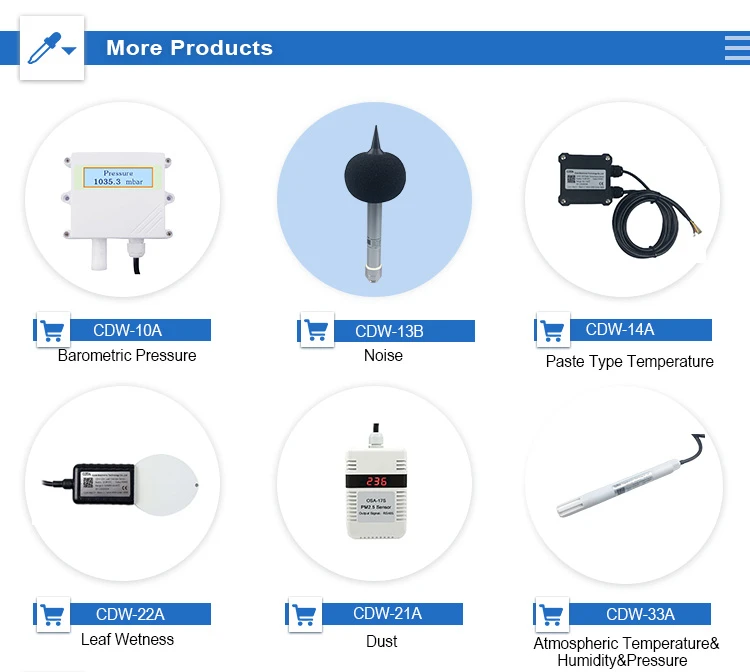
Agriculture has seen major progress by using many types of sensors. These sensors help develop smart farming practices. These sensors help collect and analyze data to boost productivity, optimize resource use, and reduce environmental impact. Below are some of the commonly used sensors in agriculture:
1. **Optical Sensors in Agriculture**
Optical sensors use light to measure soil properties. They also track light intensity on crops and soil. These sensors can be installed on vehicles, satellites, drones, or robots. They analyze reflected light and collect data on plant color and health.
Additionally, they provide insights into soil traits, such as composition, organic matter, and moisture levels.
2. **Electrochemical Sensors for Soil Nutrient Analysis**
Electrochemical sensors help collect and map soil chemical data, like nutrient levels and pH. Often mounted on special equipment like sleds, these sensors provide accurate measurements for good farm planning.
They use ion-selective electrodes to detect specific ions, such as hydrogen, nitrate, and potassium. This helps ensure an accurate assessment of soil health.
3. **Mechanical Soil Sensors**
These sensors measure soil compaction and resistance by recording force as they enter the soil. The recorded data helps determine how much effort is needed to break through soil layers during tillage or planting. Mechanical resistance is shown in pressure units. It helps analyze soil structure and its fit for farming.
4. **Dielectric Soil Moisture Sensors**
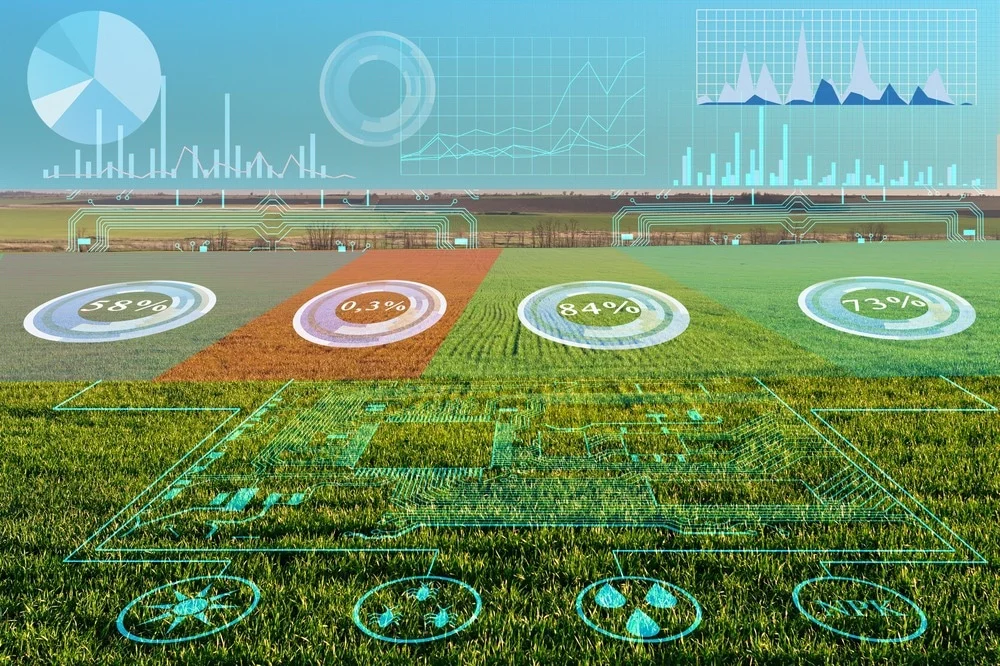
Dielectric moisture sensors measure soil water content using its dielectric constant. This electrical property changes with moisture levels.
These sensors are often linked to rainfall monitoring stations across farms. They help track real-time soil moisture changes, especially when plant cover is sparse.
5. **Location Sensors in Agriculture**
Also called agricultural weather stations, locati0n sensors are placed across fields. They capture data on variety, distance, and elevation at specific points. Using GPS satellites, these sensors provide very accurate locati0n measurements that are essential for precision agriculture.
6. **Electronic Sensors for Equipment Monitoring**
Electronic sensors are installed on tractors and other farm machinery. They monitor how the equipment operates.
Data is collected and sent through cellular or satellite systems. Farm managers can view machine performance remotely on computers or smartphones.
7. **Airflow Sensors**
Airflow sensors measure how air enters soil at specific points while moving. They calculate the pressure needed to push a set volume of air into the ground at a set depth. Different soil properties—such as moisture content, compaction level, and structure—produce unique signatures that these sensors can detect.
8. **IoT-Based Agricultural Sensors**
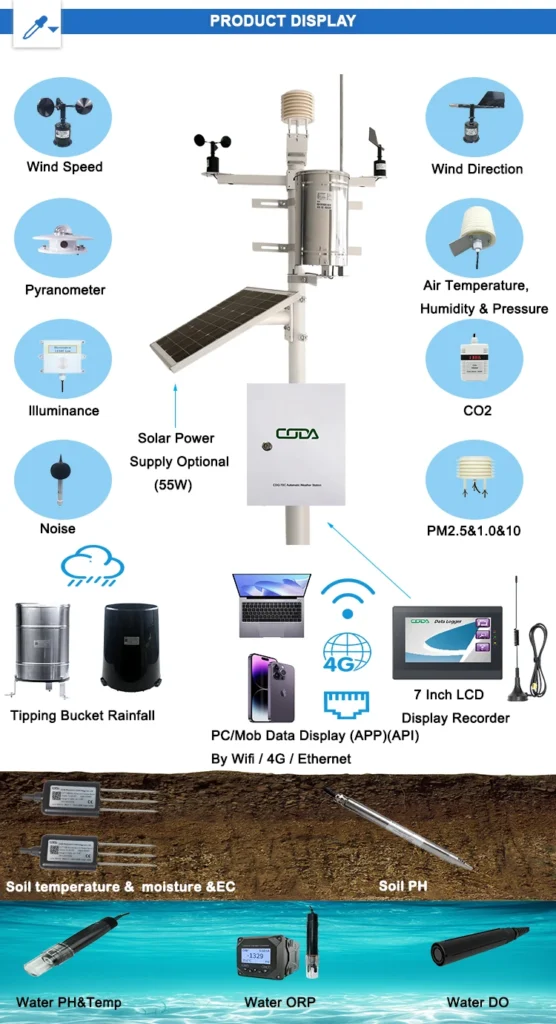
The Internet of Things (IoT) has changed agriculture by linking devices for easy data collection and analysis. IoT sensors give real-time updates on field conditions. These include air temperature and soil temperature at different depths.
They also track rainfall, wind speed, and relative humidity. They measure leaf wetness, sunlight, and dew point.
This enables farmers to monitor crop health, assess irrigation needs, evaluate soil quality, and determine optimal times for planting or harvesting based on recorded data.
By using precision agriculture sensors and IoT tools on farms, the industry can boost crop yields. It can cut losses from pests and wasted resources. It can also meet growing food needs in a sustainable way. These technologies mark a key shift toward smart farming and a stronger agricultural future.
The Most Popular Types of Precision Agriculture Sensors
Rapid global population growth has changed farming a lot, making it more complex, competitive, larger, and more efficient. To meet growing food demand, technology has stepped in. It is changing farming by boosting productivity, improving crop yields, and enhancing product quality.
A crucial aspect of this technological leap is the use of sensors. These innovative tools have become indispensable in smart agriculture. Below, we look at key sensor types shaping precision farming today.
1. **GPS Sensors**
Although people often link GPS sensors to cars and telecom, they have become a game-changer in agriculture. One of the age-old challenges in farming has been managing and tracking livestock.
Ancient methods, like herding sheep with wooden staffs, are now replaced by GPS-enabled livestock tracking systems. With one button press, farmers can track the exact locati0n of their herds and streamline operations.
In addition, GPS sensors are widely used in crop-related farming processes. They are key parts of accurate vehicle guidance systems used for planting, harvesting, and field preparation.
For instance, GPS-guided technology helps optimize field routes, reduces overlap during plowing or sowing, and cuts task time. This leads to greater efficiency and saves resources.
2. **Agricultural Temperature Sensors**
Temperature sensors are vital components of precision agriculture and are utilized in two primary applications: **ambient condition monitoring** and **mechanical asset monitoring**.
In crop production, especially for special products like ice wine, it is vital to monitor exact environmental conditions. Ice wine grapes must be picked in a short temperature window, usually between -10°C and -12°C, for the best quality.
High-accuracy temperature and humidity sensors help farmers make timely, precise decisions using reliable weather forecasts.
Beyond environmental monitoring, these sensors are also vital for managing agricultural equipment. For instance, they provide data that helps detect overheating or machine malfunctions during harvesting or planting.
They support predictive and reactive maintenance systems. This helps protect equipment from damage. It also keeps farming work running without stops.
3. **Asset Monitoring Sensors**
Temperature sensors also play a pivotal role in asset monitoring within smart agriculture. Aside from checking plants during harvest, these sensors also monitor machines. These machines are used for sowing and reaping.
When equipment fails or shows wear, like poor performance or overheating, these sensors send early alerts to fix issues fast. This early insight helps prevent major equipment failures and extends the life of farm tools. It also cuts downtime and repair costs.
4. **Accelerometer Sensors**
Much like temperature sensors, accelerometers help predict maintenance needs in modern farming. They are very useful for monitoring moving parts and motors in farm equipment. They help detect small changes in motion or vibration. These changes can signal a mechanical issue may be coming.
Accelerometers are vital for automated systems and precise tracking. For example, low-power accelerometers can monitor adjustable spray nozzles on fertilization beams faster and more accurately.
Furthermore, advanced technology like autonomous drones relies on accelerometers and inertial measurement units (IMUs).
These sensors track motion, speed, possible crashes, and how the device is oriented. These features help drones do tasks like crop spraying and field monitoring with high precision.
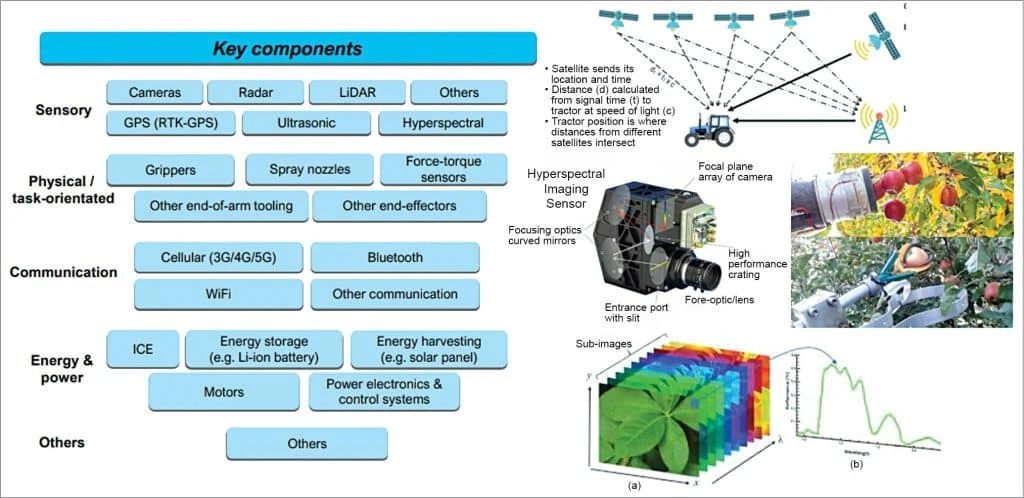
The Role of Sensors in the Future of Agriculture
The use of GPS, temperature sensors, accelerometers, and other tools in farming shows a shift to data-based agriculture. These tools boost productivity and support sustainability. They cut waste and save resources. As innovation keeps moving forward, sensors will stay central to improving farming worldwide for years to come.
Smart Camera Technology in Agriculture
Modern smart camera technology has advanced far beyond older analog sensors. It now plays a vital role in many agricultural uses.
For example, Blue River Technology, a John Deere division, uses smart cameras to spot weeds. These cameras also find plants with precision. This innovation enables automated, accurate use of herbicides and fertilizers. It optimizes chemical use, reduces waste, and boosts farm productivity.
One urgent challenge in agriculture is managing pests well. Smart cameras now help farmers spot pest infestations in real time. They can then act in a targeted way without harming helpful insects. This accuracy greatly improves pest control methods.
Smart cameras can replace older sensors, like those used to monitor ambient light. This makes systems simpler and reduces the need for extra parts. By streamlining operations, farmers can work more efficiently and still meet or exceed past data collection standards.
**Common Questions About Smart Agriculture**
1. **Why is smart agriculture important?**
Smart agriculture solves key problems by boosting productivity with data-driven methods. It supports precise management of water, fertilizers, and pesticides. This can raise crop yields and cut environmental waste.
Advanced technology gives real-time insights into weather, soil health, and crop status. It helps farmers make informed decisions quickly and reduce risks like drought or pest outbreaks.
2. **What types of sensors do agricultural robots use?**
Agricultural robots use many sensors to do specialized tasks. These include vision sensors to detect crops or objects.
They also include GPS and navigation sensors for precise positioning. Environmental sensors monitor temperature, humidity, and soil conditions. Proximity sensors help detect obstacles.
Together, these tools help robots plant seeds, spray crops, or harvest produce on their own. They do this with high accuracy.
3. **What are the limitations of agricultural sensors?**
While farm sensors offer big benefits, they also have some limits. Measurement accuracy may change at times due to outside factors or device issues.
Regular calibration or maintenance may be needed to keep it working well over time. Moreover, these devices may struggle to capture subtle environmental factors or fast changes in conditions. This could limit their ability to provide full insights.
By using smart cameras and precision tools, agriculture can grow more food. It can do this sustainably. It can also do this efficiently. This will help meet global food needs for future generations.