What is a commercial weather station?
A commercial weather station is an advanced system. It meets the needs of professionals and industry. It gives accurate, real-time weather data.
These systems are widely used in many sectors. These include agriculture, aviation, and research institutions. In these areas, accurate weather information is vital. It helps decision-making and daily operations.
From aiding climate research to improving safety in weather-sensitive industries, commercial weather stations are essential tools.
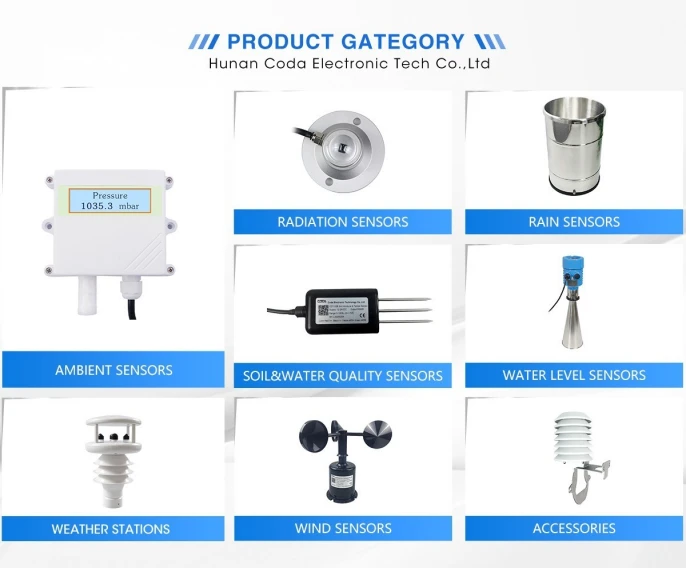
They have advanced sensors that measure many environmental factors. These include temperature, humidity, wind speed, and wind direction. They also measure rainfall, air pressure, sunlight, and soil moisture and soil temperature.
These measurements are sent to data centers or user interfaces by wired or wireless methods. This gives you quick access to the information.
Key Features and Advantages
1. **High Precision and Real-Time Data:**
Commercial weather stations use advanced sensors to track weather in real time. They measure temperature, humidity, wind, and rain accurately.
2. **Multiple Communication Options:**
Equipped with flexible communication modes, these systems ensure reliable data transfer.
They support wired options (RS232/RS485/USB).
They also support wireless technologies like LoRa, GPRS, 4G, 5G, Wi‑Fi, and satellite. And they also let you access them remotely from almost anywhere.
3. **Customizable Services:**
Users can personalize weather data services by locati0n, timeframe, or specific weather elements. They will receive precise updates that match their needs.
4. **Intelligent Data Analysis:**
Advanced analysis tools built into the stations enable deep data mining and useful insights. This helps users fully understand weather changes and their effects, so they can make informed strategic decisions.
5. **Enhanced Scalability and Compatibility:**
These stations scale well and integrate easily with other systems or added sensors. This flexibility helps them stay useful and effective as user needs change over time.
6. **Durability and Reliability:**
Designed for tough environments, they have a strong build. They are waterproof, dustproof, and corrosion-resistant. They can handle harsh weather and keep performance steady.
7. **Remote Monitoring and Alerts:**
Integration with cloud platforms, mobile apps, and APIs lets users monitor weather conditions remotely. The system can send automatic alerts when set limits are exceeded. This helps ensure quick responses to potential hazards.
1.Hardware and Software Components
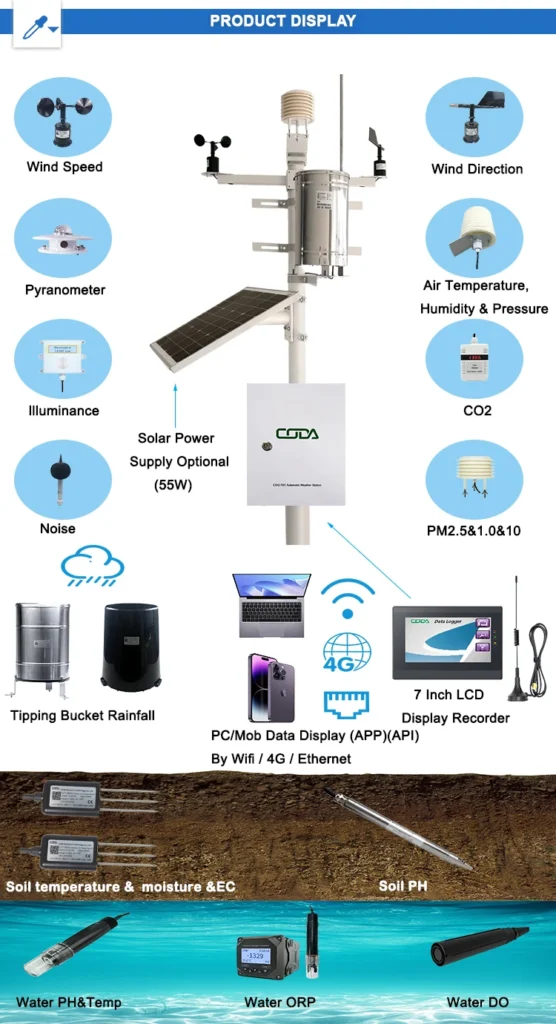
– **Sensors for Various Measurements:**
– Temperature sensor: Monitors air temperature.
– Humidity sensor: Captures relative humidity levels.
– Wind speed and direction sensors: Measure the speed and direction of the wind.
– Barometric sensor: Records atmospheric pressure.
– Rain gauge: Tracks precipitation.
– Solar radiation sensor: Measures various types of solar radiation.
– Soil moisture and temperature sensors: Monitor ground conditions.
– UV sensor: Gauges ultraviolet light intensity.
– Air quality sensor: Detects pollutant levels in the atmosphere.
2. Data collector:
– Designed to collect sensor data. It also performs basic processing and storage tasks. Typically includes features like data logging, calibration, alarm alerts, and other useful functions.
**Intelligent Data Collectors**
3. Communication equipment:
– **Wired communication:** Connects to the monitoring center using RS232, RS485, or USB. It works best for short to medium distances.
– **Wireless communication:**
– Short-range wireless transmission: Ideal for campuses or field areas. It uses microwave radio signals over 0 to 300 meters.
– Medium-range wireless transmission: Uses radio technology. It works for longer distances when wired connections are impractical. It can cover up to 2,000 meters.
– Long-range wireless digital transmission: Uses GSM/GPRS networks or 4G/5G technology. It supports remote monitoring over any distance. Billing is based on data traffic.
– Satellite communication: Helps send data worldwide, especially where there is no ground network coverage. It also supports remote locations using satellite systems.
**Automatic Weather Station Data**
4. Software platform:
– **Data management and analysis:** Offers strong tools for data charts, trend tracking, report creation, and deeper analysis.
– **Remote monitoring and alarm:** Enables real-time monitoring of weather data, alarm alerts, and analysis on web or mobile apps.
– **API interface:** Allows easy integration of data into third-party or custom platforms to meet specific user needs.
**Application Areas of Commercial Weather Stations**
1. **Agriculture:**
– **Irrigation and crop management optimization:** Provides real-time monitoring of farm microclimates. It supports data-based decisions on irrigation, fertilization, and other practices. This helps improve crop yield and quality.
– **Meteorological disaster prevention:** Delivers early warnings for natural disasters like frost, drought, or flooding. Helps farmers act early to reduce losses.
2. **Energy:**
– **Wind energy production:** Monitors wind speed, wind direction, and other weather factors to guide turbine operation and energy management.
– **Solar power generation:** Measures solar radiation to predict energy output. Helps optimize power station operations.
– **Power supply companies:** Tracks weather to help prevent grid failures and ensure stable, reliable power delivery.
**MQTT eather Stations**
3. **Transportation:**
– **Airports:** Supplies real-time weather updates to ensure safe take-offs, landings, and precise flight path planning.
– **Ports:** Monitors sea weather like wind speed and wave height to keep ships safe entering and leaving port.
– **Highways:** Provides updated road and weather information to help traffic management agencies improve route optimization, lower transportation costs, and enhance passenger satisfaction.
4. **Construction:**
– **Site monitoring:** Tracks weather to keep construction sites safe and improve schedules and material use.
– **Material durability studies:** Assesses how long materials last when exposed to sunlight and other environmental factors over time.
5. **Environmental Protection and Research:**
– **Air quality monitoring:** Tracks air pollution levels to support research and help shape policies to reduce pollution.
– **Water quality monitoring:** Measures temperature and dissolved oxygen in aquatic systems. This helps conserve water and support sustainable ecosystems.
– **Climate change research:** Offers large weather datasets for global climate studies. Supports climate change research and model development.
6. **Meteorological Service Providers:**
– Delivers accurate weather data and clear insights to support forecasting firms and climate consulting services.
7. **Outdoor Activities and Tourism:**
– Gives real-time weather updates for places like ski resorts, golf courses, or national parks. This improves safety and outdoor activities.
8. **Water Resources Management:**
– Helps manage reservoirs and dams by tracking rainfall and water levels to improve water use and support flood control.
Selection of Suitable Commercial Weather Stations
When choosing a commercial weather station, you must review key factors. This helps make sure it fits your needs. These include:
1. **Monitoring Needs**
– Identify the weather factors to monitor, such as temperature, humidity, wind speed, air pressure, and rainfall.
– Decide if you need special sensors to measure ultraviolet light, soil moisture, or pollution levels.
2. **Accuracy and Reliability**
– Choose weather stations with high-precision sensors to ensure accurate data collection.
– Research user reviews and reliability records. Choose a well-known, trusted brand.
3. **Data Recording and Transmission**
– Verify the station’s data logging features, including storage capacity and frequency of recordings.
– Review the data transfer method (wired or wireless) and confirm it supports remote access.
– Ensure it stays stable and secure.
4. **Software Support and Compatibility**
– Choose weather stations with strong software tools for advanced data analysis and report creation.
– Ensure the software works with current IT systems. This supports smooth integration and easy use.
5. **Installation and Maintenance**
– Consider how easy it is to install based on the location. Also, assess the maintenance effort needed.
– Check if professional installation and maintenance support are available. This helps ensure stable operation over the long term.
6. **Budget**
– Select equipment that balances cost and function. Stay within your budget.
– Account for ongoing costs, like sensor calibration and data fees, when you estimate the total ownership cost.
7. **Expandability and Upgradability**
– Factor in future needs for extra sensors or features. This helps ensure the equipment adapts to changing requirements.
8. **Compliance and Certification**
– Confirm the chosen weather station meets industry standards and certifications. This helps ensure it is valid and reliable.
Summary
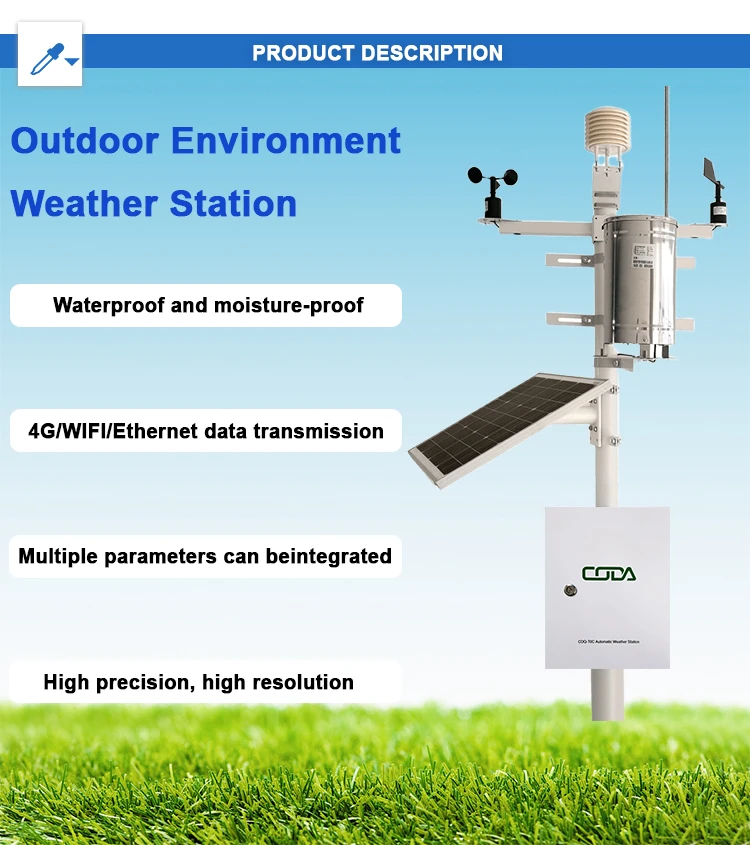
Commercial weather stations are advanced systems. They are designed for automatic, professional weather observation. They offer high accuracy, real-time monitoring, multiple communication options, customizable service capabilities, intelligent analytics, and scalability for various applications.
These systems are used in farming, energy, transport, construction, environmental protection, and weather forecasting. They support data-driven decisions using real-time weather data.
Selecting the right commercial weather station means reviewing several key factors.
Consider your monitoring needs and required accuracy. Check data management features and software integration.
Look at installation and maintenance needs. Keep your budget and future scalability in mind.
Confirm it meets relevant industry standards. Proper review of these points helps ensure the equipment provides reliable weather data for your specific needs.