



How do cup anemometers differ from propeller anemometers in practice?
Cup anemometers and propeller anemometers both measure wind speed. They differ in design, operation, and use.
**Working Principle**
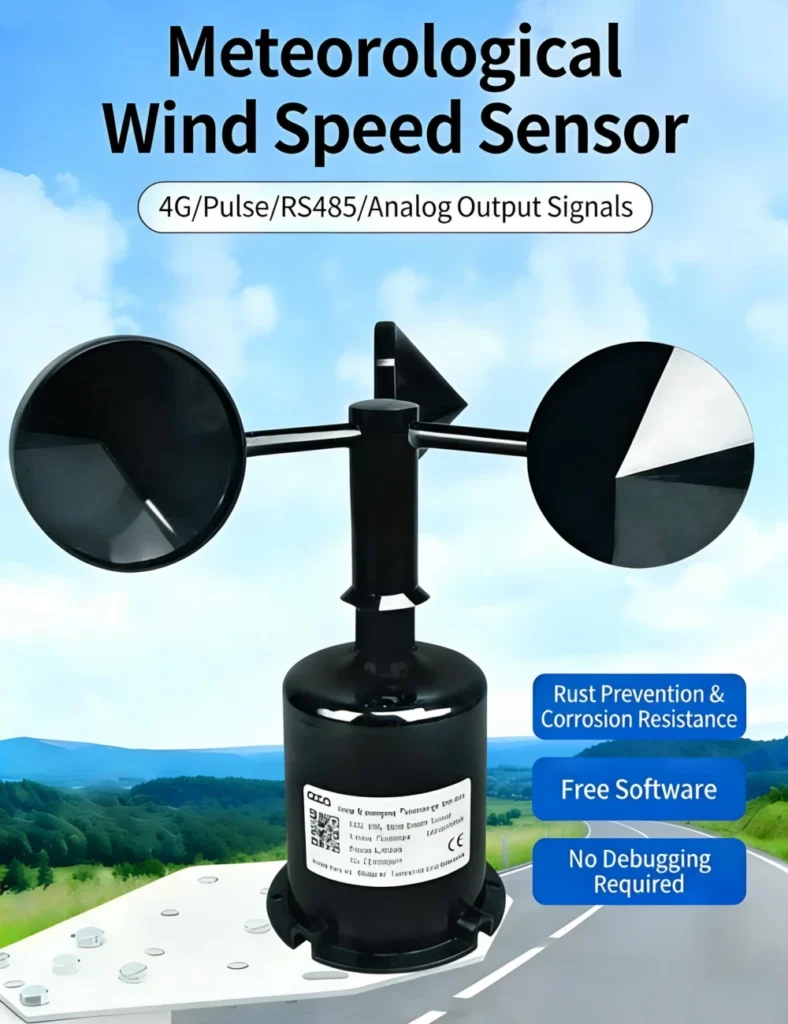
A cup anemometer uses one or more wind cups. The cups are often made of light material. They can rotate freely. When wind flows through the cups, they spin. This happens due to rotational resistance and the wind’s inertial force.
The rotation speed, or angular velocity, goes up with stronger wind. By measuring this angular speed, we can calculate the wind speed.
A propeller anemometer uses a small propeller as its main sensing part. When wind passes over the propeller, it rotates, and the speed of its rotation is directly proportional to the wind speed. Wind speed is measured by checking how fast the propeller spins.

**Structure**
The cup anemometer has a stand, wind cups, and a measurement circuit. The wind cups are the main part. They sense the wind’s force and spin with it.
The measurement circuit has a sensor and a signal processing unit. It converts the cups’ angular velocity into a wind speed reading.
The propeller anemometer has a bracket, a propeller, and a measurement circuit. The propeller is the main part. It rotates when the wind blows.
Like the cup anemometer, its system uses sensors and signal processors.
They measure the propeller’s rotation speed and convert it to wind speed data.


**Summary**
In conclusion, both devices measure wind speed. Their key difference is how they work. Cup anemometers measure wind speed by tracking how fast their cups spin. This makes them useful for weather and environment monitoring.
Propeller anemometers rely on the rotation speed of a propeller. They are often used in specialized fields. These include aerospace and energy uses.