

Anemometer: Types, Benefits, and Limitations
What is an anemometer?
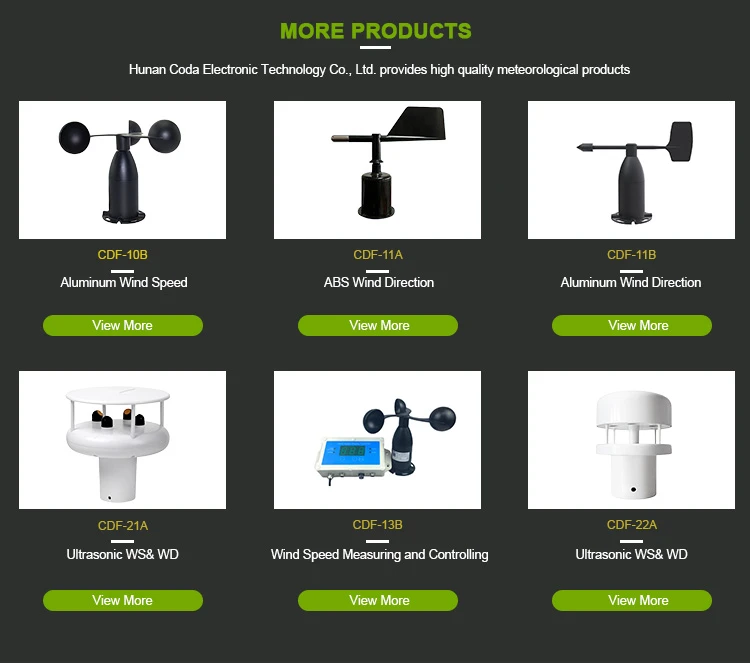
An anemometer is a tool that measures how fast the air is moving. It is often called a wind sensor. These tools have been used for many years. They were first made to measure wind speed.
Modern anemometers now give accurate and varied data thanks to advances in technology.
There are many types of anemometers available today. Some are very common, while others are more specialized. Choosing the right anemometer for your needs can be a tough job.

**Key Applications of Anemometers**
– Measuring how fast and in what direction the air flows on average.
– Monitoring the speed and frequency of airflows.
– Assessing Reynolds stress in turbulent flows, as well as speed and time correlations between two points.
– Measuring wall shear stress can be done with a hot film probe. This probe is placed flush against the wall. It works on principles like those used in hot-wire velocity measurement.
– We record fluid temperature by tracking how probe resistance changes with temperature changes.
**7 Types of Anemometers**
**1. Cup Anemometers**
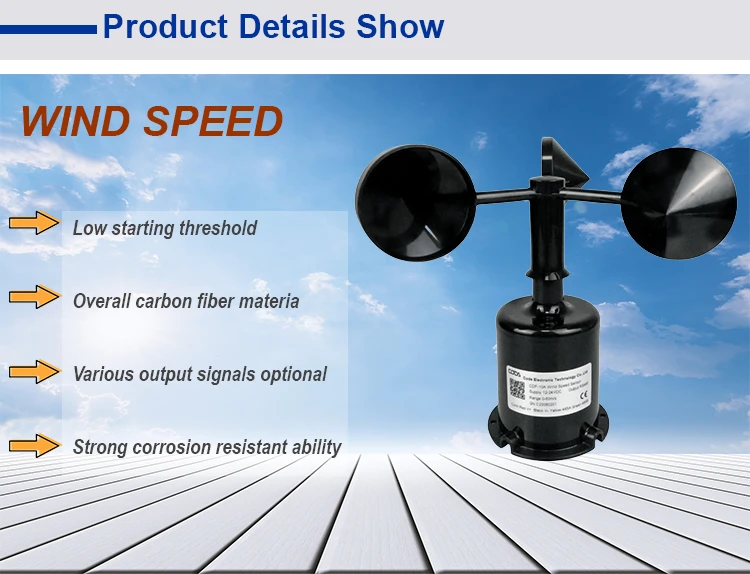
This is one of the most commonly used types of anemometers. The cup anemometer was first made by Ruby Sun in England. It originally had four cups.
Later, John Patterson changed the design. He reduced the number of cups to three. This design has three parabolic or hemispherical cups.
They are fixed to one side of a frame. The frame can rotate freely on a shaft. The wind makes the cups spin around their axis. The speed of rotation is directly related to the wind speed.
Measurements are taken with devices such as electrical contacts, tachogenerators, or photoelectric counters. The three-cup anemometer is often used in weather stations because it works well.
*Advantages*:
– Widely used due to its practicality.
– Covers a broad range of wind speeds.
– It uses strong and rust-resistant materials like aluminum alloy or polycarbonate. This makes it easy to afford and flexible.
*Disadvantages*:
The design of wind cups depends mostly on experimental results and data. It is not based on clear theoretical frameworks. Some factors, like how well the device works in a straight line, are not well understood or standardized.

**2. Propeller Anemometers**
This type has three or four blades. They form a propeller that spins around a horizontal axis. It is placed on the front of a weather vane. This keeps the propeller aligned with the wind’s direction.
The propeller’s rotation plane matches the wind’s direction. Its speed shows how fast the wind is blowing. Its weather vane looks like the body of an airplane. This helps create smoother airflow.
*Advantages*:
– User-friendly and widely applicable.
– Built with corrosion-resistant materials for durability in various environments.
*Disadvantages*:
– The propeller mechanism can freeze in cold weather. This is especially true where the blade meets the fuselage. This can limit how well things work in winter. It may cause gaps in weather data collection for a long time.
**3.Hot-Wire Anemometers**
A hot-wire anemometer measures wind speed. It changes airflow signals into electrical signals. The device uses a thin metal wire. This wire gets hot when electricity passes through it. This wire is placed in the airflow.
As air moves over the wire, it loses heat based on the flow rate. This heat loss makes the hot wire’s temperature change, which changes its resistance. These changes are turned into electrical signals. These indicators display the speed of flow.
There are two categories of hot-wire anemometers: direct heating and indirect heating. Indirect heating usually uses manganese copper wire. This wire has a temperature coefficient of resistance that is almost zero. It is also supported by extra temperature-sensing elements on its surface.
Direct-heating models usually use platinum wire. This cable is capable of simultaneously measuring temperature and recording wind speed. These anemometers are great at detecting low wind speeds.
They are perfect for measuring small airflow rates. With a quick time constant of just a few hundredths of a second, they are essential tools. They help us learn about weather changes and farming conditions.
Advantages include high sensitivity at low wind speeds, easy portability, user-friendliness, and operation without special software.
However, there are some downsides. One reason is that changes in temperature can lead to measurement errors. Hot-wire anemometers are often quite expensive.
**4.Vane Anemometers**
A handheld vane anemometer is used to measure the speed of wind. It has a rotating wheel with blades. It usually comes with an impeller and a counting mechanism.
The instrument measures wind speed by counting how many times the impeller spins each minute due to airflow. These small, battery-powered devices are great for outdoor activities. They are useful for camping, hiking, sailing, and hunting. Knowing the wind direction or speed can be very important in these situations.
Vane anemometers have many advantages. They are small and easy to carry. And they are simple to use and do not need installation. They are also affordable and look good.
Disadvantages include a limited wind speed range, no remote data viewing, and the need to replace batteries often.

**5.Ultrasonic Anemometers**
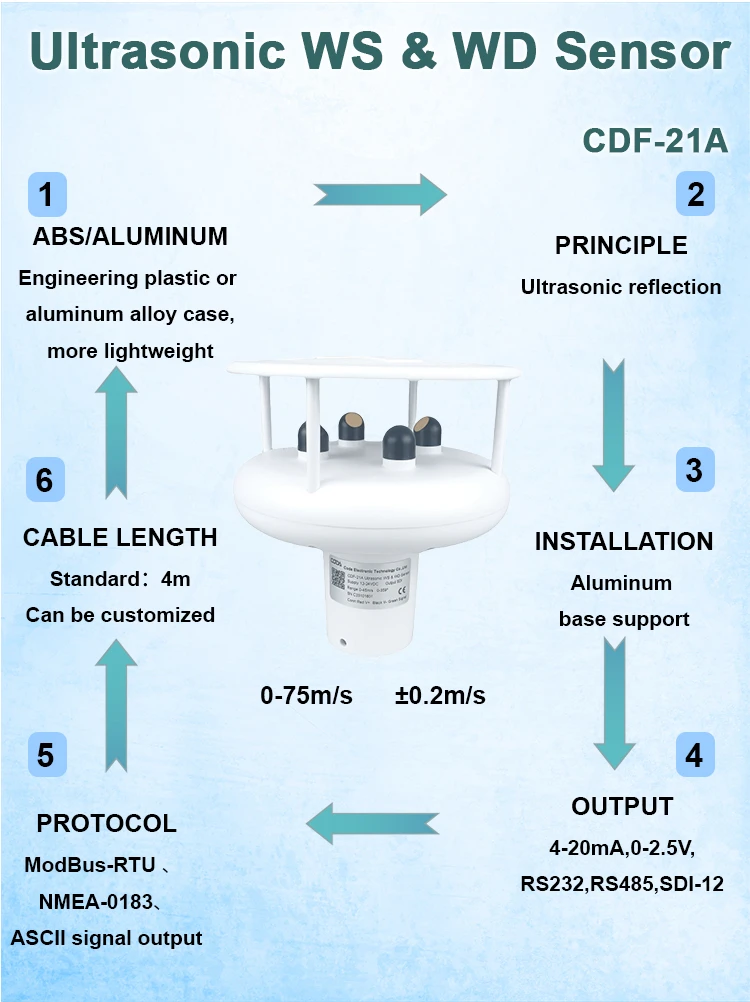
An ultrasonic anemometer is an advanced device used to measure wind speed and direction. It uses sound pulses to measure time differences or frequency shifts. This helps determine wind characteristics at the receiving end.
The principle is based on how fast sound waves travel in the air and the airflow. By comparing how long sound waves take to travel downwind and upwind over the same distance, we can find the air speed. This process allows for accurate measurement of wind speed and direction. It does not depend on moving mechanical parts.
Ultrasonic anemometers are known for overcoming the limits of traditional mechanical ones. They can work well in different weather conditions for long periods. Ultrasonic anemometers are becoming more popular because they are reliable and have advanced features. They are often chosen over mechanical ones.
They have benefits like no moving parts, which means no mechanical wear. And they respond quickly and are very sensitive. They can also detect wind speeds as low as a few centimeters per second.
However, there are some downsides. These include more complicated installation steps and higher costs to buy.
**6. Pressure Anemometers**
Pressure anemometers determine wind velocity by examining the disparity between total and static pressures. They use a dual Pitot tube system. One nozzle faces the airflow to measure total pressure.
The other nozzle is behind the airflow. It experiences lower pressure because of the suction effect. The difference in pressure between the two nozzles is related to the wind speed.
The most widely used pressure anemometer is the Pitot tube, named after Henri Pitot, its inventor and a French engineer. The Pitot tube has two parts: a total pressure probe and a static pressure probe. Wind speed is calculated using dynamic pressure. This pressure comes from the difference between total pressure and static pressure in the airflow.
At the end of the Pitot tube, a small hole faces the incoming flow. This hole measures total pressure. Several small holes are placed in the pipe wall. They are about three times the pipe’s diameter from the head.
These holes collect static pressure when the pipe is working. These holes are linked by two pipelines to a pressure gauge. The wind speed at a certain point is measured using gauge readings and calculations.
Advantages: It has high stability. It can measure positive, negative, and differential gas pressures up to 3000 Pa. It is also good for measuring wind speed and air volume.
Disadvantages: It is limited to certain environments, which makes it less flexible.
**7. Tube Anemometers**
Tube anemometers are made to measure wind speed in pipes or small spaces. They use a high-precision sensing unit. It can accurately detect low wind speeds and is very stable.
They can also calculate real-time airflow values. This is based on the pipe’s cross-sectional area. They use a special circuit design that helps prevent interference.
This design helps against environmental electromagnetic disruptions, like those from inverters. With screwless terminal wiring, installation becomes more convenient.
These devices measure wind speed using the hot-wire balance principle. They provide quick response times and can detect very low starting wind speeds.
Advantages: Very accurate for small areas like HVAC ducts or pipes.
Disadvantages: Installation needs changes like punching, which makes setup more complicated.

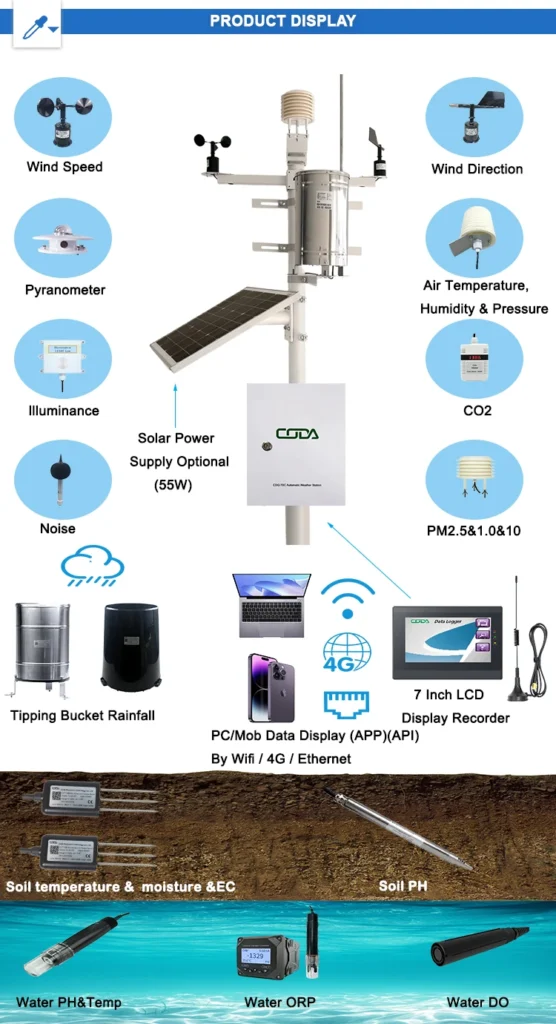
How to Choose a Suitable Anemometer
**Range**
There are many types of anemometers. It is important to know your needed wind speed range. You should also consider extra features, like measuring temperature or humidity. Think about whether your application would work better with a mains power supply or a battery-powered option.
**Precision**
Anemometers available in the market have precision levels between +/- 0.2% and +/- 2%. More accurate devices usually cost more. It is important to choose an anemometer that meets your needs and fits your budget. This helps you save money.
**Quality**
Anemometers made with strong materials and sturdy housing last longer. This is especially true for outdoor use or tough conditions. Buying better quality devices can lower maintenance costs in the long run.
**Application**
Determine the locati0n for using the anemometer, whether it be outdoors, in factories, or laboratories. Make sure it meets the environmental needs and safety standards.
Choose models that are simple to install and use. Most anemometers include the needed accessories for setup.
**After-Sales Service**
Good after-sales support is important for fixing problems that may come up during installation or use. Good customer service helps projects run safely and smoothly.
**Conclusion**
Many types of anemometers are available to meet various needs and uses. By knowing the specific use cases and preferences, you can choose the best model. If you need help or have questions about choosing the right anemometer, our team is here to assist you.