



What is a Weather Station Used For?
A weather station is a place with accurate tools. It observes, measures, records, and studies weather conditions. It is the main data source for weather forecasts, climate studies, disaster prevention, industry, farming, and daily life.
By tracking key weather variables, stations turn unseen changes in the air into useful data. This data supports safety, efficiency, and sustainability around the world.
Core Definition and Basic Functions
At its simplest, a weather station collects real-time and past data about the atmosphere and near-surface environment. Standard measurements include:
Air temperature
Atmospheric pressure
Relative humidity
Wind speed and direction
Precipitation amount and intensity
Sunshine duration and solar radiation
Visibility and cloud conditions
Soil temperature and moisture
Evaporation rate
These observations follow World Meteorological Organization (WMO) standards. This ensures consistency and comparability across national networks.
Modern weather stations are mostly automated. They run 24/7 without human help. They send data wirelessly to centers for quick processing.

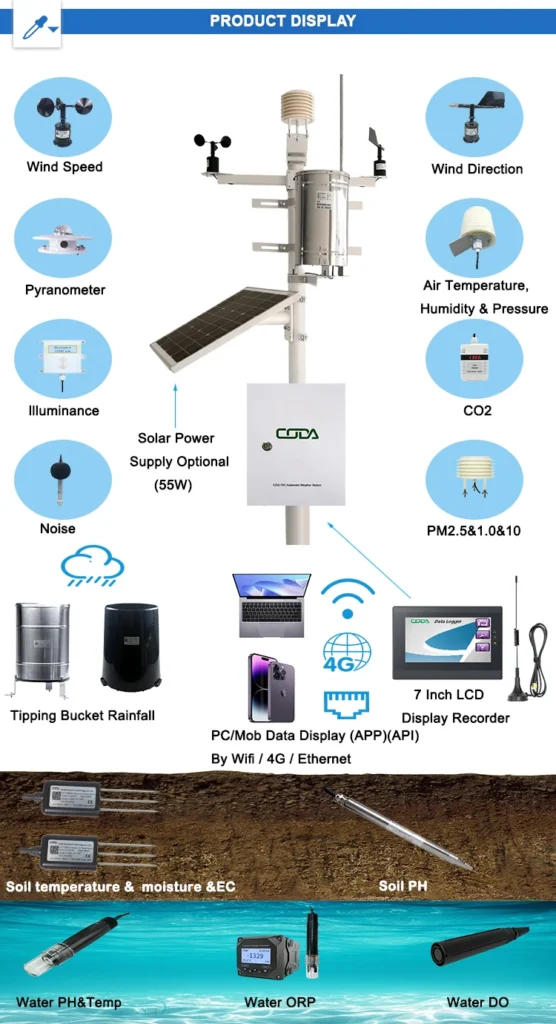
The main purpose of a weather station is to turn raw weather readings into useful insights. Unlike simple thermometers or rain gauges, a full weather station gives linked, calibrated data over time. This supports scientific analysis and daily decisions.
1. Weather Forecasting and Early Warnings
The most well‑known use of weather stations is to power accurate forecasts and severe weather alerts.
Meteorological agencies use many weather stations to map current weather systems. They track pressure systems, frontal boundaries, and wind shifts.
Real-time data feeds weather prediction models, improving short-term and medium-term forecasts.
Stations detect early signs of hazards: heavy rain, thunderstorms, strong winds, frost, heatwaves, and blizzards.
Timely warnings help governments, emergency services, and the public prepare. They also help people evacuate when needed.
Without weather stations, forecasts would be vague and unreliable. They are the “eyes and ears” of meteorologists. They capture local conditions that satellites cannot always see clearly.
2. Climate Monitoring and Climate Change Research
Weather stations play a vital role in long-term climate research.
Decades of consistent measurements show global and regional trends. Average temperatures are rising. Rainfall patterns are shifting. Wind patterns are changing. Extreme weather is happening more often.
Data backs reports from the IPCC and national climate groups. It helps guide climate policy around the world.
Historical records help separate natural climate changes from human-caused changes.
Researchers use station data to check satellite and model estimates of climate conditions.
Long‑term weather station archives are among the most important evidence for understanding Earth’s changing climate.
3. Agricultural Production and Precision Farming
Agriculture is one of the sectors that depends most on weather station data.
Monitor temperature, rainfall, humidity, and soil moisture. Use this data to improve planting, irrigation, and harvest schedules.
Predict frost, heat stress, and drought to protect crops.
Track leaf wetness time to predict disease and pest outbreaks.
This helps cut unnecessary pesticide use.
Calculate evapotranspiration to support smart irrigation systems. These systems save water and boost yields.
Support orchard, vineyard, and greenhouse management with microclimate monitoring.
Weather stations help farming shift from “relying on heaven” to “using knowledge.” This greatly improves stability and profit.
4. Aviation, Maritime, and Transportation Safety
Safe and efficient transportation depends on real-time weather reports.
Aviation
Airport weather stations measure wind, visibility, cloud height, temperature, and pressure.
Data helps ensure safe takeoffs and landings, even in fog, storms, or icy conditions.
Supports route planning to avoid turbulence and unsafe weather.
Maritime
Coastal and offshore weather stations track wind, waves, fog, and storms.
Improve safe navigation for ships, fishing boats, and offshore platforms.
Issue typhoon and storm surge warnings.
This will help protect coastal communities.
Road and Rail
Road weather stations detect pavement temperature, ice, snow, and flooding.
Alert traffic managers and drivers to dangerous conditions. This can reduce accidents.
5. Disaster Prevention and Mitigation
Weather stations are frontline defenses against natural disasters.
Monitor heavy rainfall to predict floods and flash floods.
Detect strong winds and hail to warn of thunderstorm damage.
Track extreme heat and cold to protect public health.
Support wildfire risk assessment using temperature, humidity, and wind data.
Provide rapid deployment mobile stations in disaster zones for emergency response.
By giving early warnings, weather stations save many lives and cut billions in losses each year.
6. Energy and Utility Management
The energy industry relies on weather data to balance supply and demand.
Wind and solar power: Measure wind speed, sunlight, and temperature. Use this data to predict energy output.
Grid management: Anticipate high demand for heating or cooling during temperature extremes.
Hydropower: Use rainfall and evaporation data to manage reservoir levels.
Oil and gas: Monitor offshore weather to ensure safe drilling and transport.
Weather stations help predict renewable energy and keep the power grid stable.


7. Construction, Engineering, and Urban Planning
Large projects need accurate weather data to keep work safe and high quality.
Monitor wind speed to run cranes safely. This helps avoid damage and structural risks.
Track temperature and humidity for proper concrete curing.
Avoid construction delays from rain, snow, or extreme heat.
Support urban design: ventilation, heat island effect, drainage planning.
Assess long‑term weather risks for bridges, dams, and high‑rise buildings.
8. Environmental Monitoring and Ecology
Weather stations work alongside environmental sensors to protect ecosystems.
Monitor air quality, pollution dispersion, and greenhouse gas levels.
Study ecological changes. Track plant phenology and animal habitats. Monitor glacier melt and coastal erosion.
Support water resource management and drought monitoring.
Provide data for environmental impact reviews of development projects.
9. Daily Life and Public Services
Weather stations help improve the quality of life for everyday people.
Support daily forecasts for clothes, travel, outdoor activities, and events.
Help schools, hospitals, and businesses prepare for bad weather.
Assist sports events, film production, and outdoor operations.
Enable personal weather monitoring for homes, gardens, and hobbies.
Types of Weather Stations and Their Uses
Different stations serve different needs:
Automatic Weather Stations (AWS): Most common. They monitor weather 24/7 for general use.
Agricultural Weather Stations: Focus on soil, crop, and microclimate data.
Aviation Weather Stations: High‑frequency updates for runways and air traffic.
Marine and Buoy Stations: Monitor ocean and coastal weather.
Portable/Mobile Stations: Used for emergency response. Used for field research. Used for temporary sites.
Urban Weather Stations: Track city heat, air quality, and traffic-related conditions.
Conclusion
A weather station is far more than a tool to “check the weather.” It is a critical infrastructure that connects the atmosphere to human activity. From global climate science to local farming, weather stations help us understand nature.
They also help us adapt to changing conditions. They help us thrive. Weather stations also support aviation safety and disaster relief.
As technology improves, weather stations get smarter, smaller, and more connected. They keep evolving with our needs. And they support sustainable development and public safety. They also help build a more resilient future for everyone.
In short, weather stations matter because they turn doubt into knowledge, and knowledge into action.