


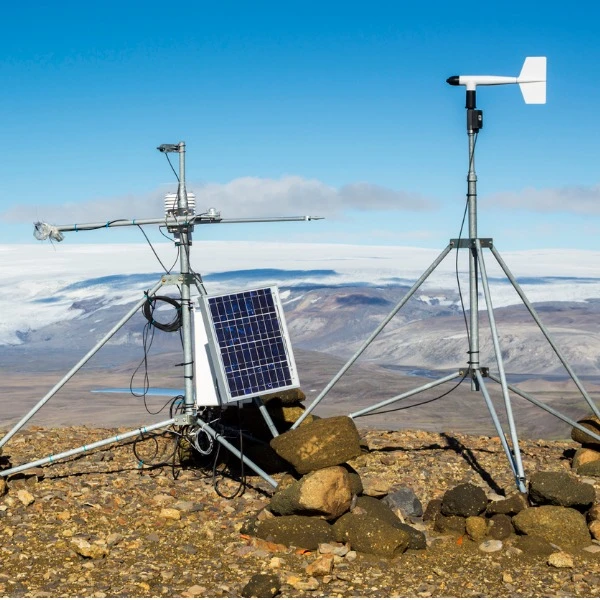
What Instruments Are Included in a Weather Station?
Modern weather stations are small. They are 158 mm tall and 93 mm wide. These stations can measure six important weather factors. They use advanced ultrasonic technology to detect wind speed and direction.
They also measure air temperature, humidity, air pressure, and sunlight accurately. And they are built to last, need little maintenance, and provide precise measurements.
A typical ultrasonic weather station weighs under 0.5 kg. It is light and can be used in many ways. This is great for many things. You can use it for farming, managing renewable energy, and studying climate.
Farmers can improve their irrigation methods. Solar panel operators can change the angles of their panels. Local authorities can improve their plans for stormwater management.
All weather stations measure similar environmental factors. However, their sensor technologies, accuracy, and measurement resolutions can vary a lot. Choosing the right weather station for you means knowing its tools and features.
This guide looks at the key tools in weather stations. It also includes various types of stations, such as professional weather systems. It also answers common questions to help you make smart choices.

1. Types of Weather Stations
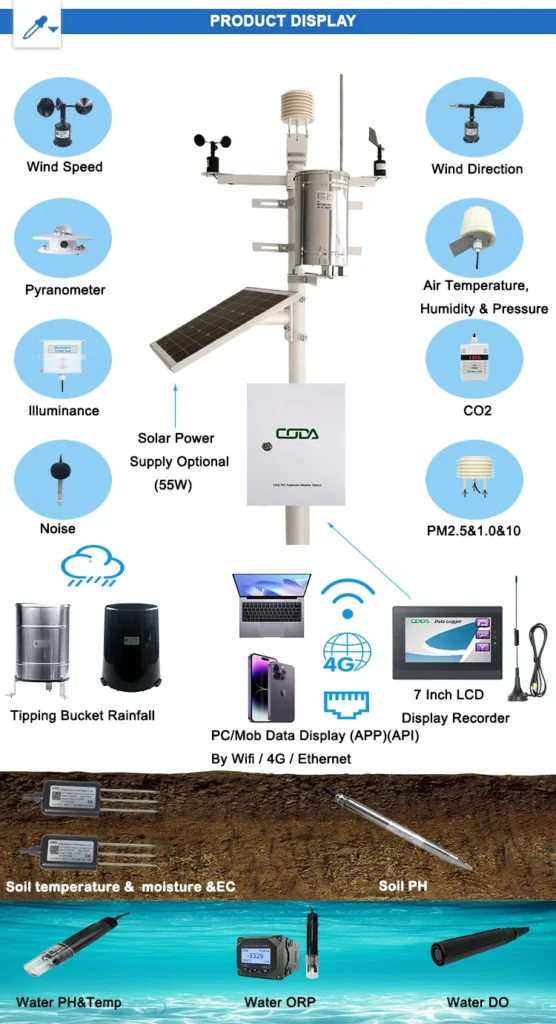
There are different types of weather stations, and each one is made for a specific purpose. Knowing their design goals can help find the right uses for different needs. Here is a detailed look at these types:
1.1 General-Purpose Weather Stations
General-purpose weather stations measure basic weather factors. These include wind speed, temperature, humidity, air pressure, and rainfall. These essential tools provide baseline data for analyzing weather conditions.
**Equipment:** – Wind direction gauge
– PAR detector
– Light intensity sensor
– Wind speed meter
– Solar radiation sensor
– Soil nutrient sensors
– Air temperature and humidity sensor
**Uses:** Airports, research facilities, and weather agencies.
1.2 Agricultural Weather Stations
Agricultural weather stations use special sensors along with regular weather tools. They check the soil and crop conditions. These stations act as central points to gather important field data.
They enable farmers to watch their crops in real-time. This helps them make better decisions about farming. Many can run all the time. They offer features like special lights for growing plants at night.
**Equipment:**
– Leaf wetness sensor
– Soil moisture and temperature sensor
– PAR sensor
– Crop canopy temperature sensor
– UV radiation sensor
– New infrared leaf surface temperature sensor
**Applications:** Irrigation optimization helps us use water better. Pest and disease forecasting predicts problems for plants. Crop yield estimation estimates how much food we can grow.
Using safe pesticides and fertilizers helps keep plants healthy. Microclimate evaluation checks local weather conditions. Harvesting schedule planning decides the best time to pick crops.
1.3 PV (Photovoltaic) Monitoring Stations
The use of clean energy technologies has led to the growth of solar PV farms. These farms rely on weather stations to watch and improve their operations. These stations are designed for solar energy management.
They check things like solar radiation and the temperature of PV modules. By fixing temperature-related drops in efficiency, they can turn on cooling systems to improve performance.
**Instruments:** Irradiància Horitzontal Global (GHI), Irradiància Inclinada Global (GTI), Irradiància Normal Directa (DNI), sensors de temperatura dels mòduls fotovoltaics i sensors de temperatura ambiental.
**Applications:** PV farms help improve the performance and efficiency of solar modules.

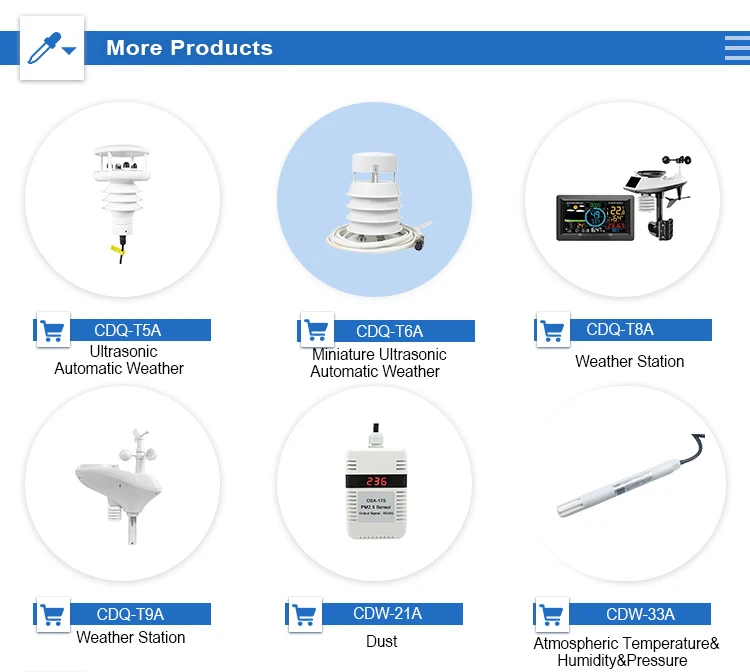
1.4 Ultrasonic All-in-One Stations
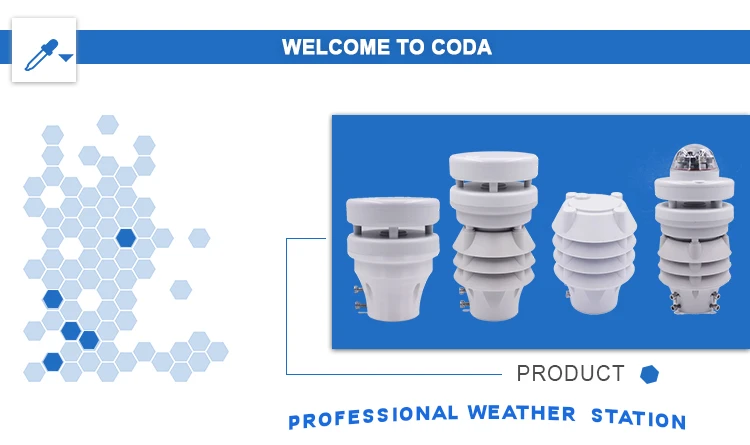
Ultrasonic all-in-one stations use advanced electronics instead of traditional mechanical parts. They use sound waves that are too high for humans to hear to measure wind.
They use radar to study rain and snow. Solid-state detectors measure various parameters. These tools are strong and precise. They also need less maintenance.
**Instrumentation:** Ultrasonic sensors measure how fast the wind blows and which way it is going. Other sensors track air temperature, humidity, and barometric pressure.
Radar detects rainfall. Solar radiation sensors measure sunlight. UV index monitors check harmful rays. Illuminance tools measure light levels.
Noise level monitors track sound. Particulate matter sensors measure two types of particles: PM2.5 and PM10. Visibility systems check how far you can see.
**Applications:** Smart city projects include airports, highways, and systems for monitoring the environment. They also involve industrial areas and remote weather monitoring setups.
1.5 Miniature Weather Stations
Miniature weather stations are ideal where space or weight constraints exist. They are small but useful. They provide basic weather monitoring.
And they are great for portable setups or remote areas. They need little maintenance and are very durable.
**Instrumentation:** Sensors measure wind speed and direction with ultrasound. They also monitor air temperature and humidity.
Barometric pressure gauges measure air pressure. Solar radiation meters check sunlight levels. Some devices can also detect rain.
**Applications:** – Mobile weather tracking and drones for sensing the environment must be easy to carry.
– Small research units and remote setups also require portability.
– All of these should use little space.

2. Instruments Found in a Weather Station
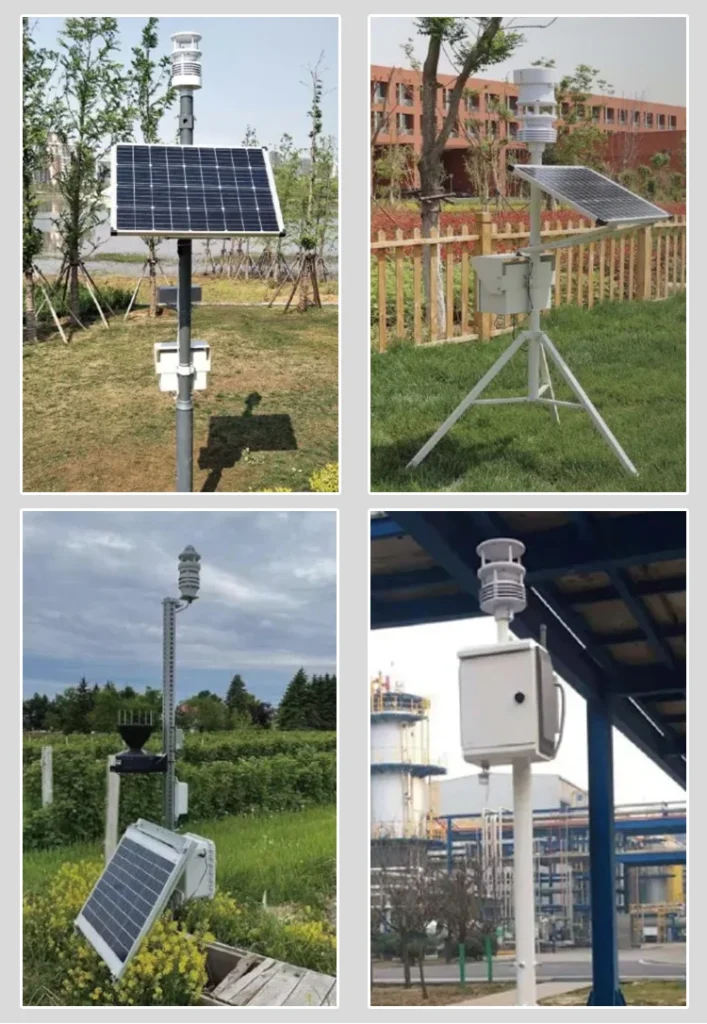
Understanding the sensors included in various types of weather stations is essential to grasp their importance. The accuracy of these tools can vary based on the detection method used.
Manufacturers can use different types of sensors. They do this to meet various needs like cost, accuracy, speed, or range. This section discusses the different types of weather station sensors and what they can measure.
2.1 Wind Measurement Instruments
Wind plays an important role in predicting the weather. It is driven by the uneven heating of the Earth’s surface by the sun and the planet’s rotation. Wind carries heat, moisture, pollutants, and pollen to various places. This impacts the weather in local and regional areas.
2.1.1 Wind Speed Sensors
Measuring wind speed is essential in fields like aviation and meteorology. Weather stations commonly employ two types of technology for wind speed detection: cup anemometers and ultrasonic sensors.
– **Cup Anemometer**:
Cup anemometers were created in 1846. They are tools made of metal or plastic cups. These cups spin when the air moves.
Manufacturers set the rotation rate to match the wind speed. Their ability to detect usually includes:
– Measurement Range: 0–30 m/s or 0–60 m/s
– Precision: ±0.5 m/s for speeds below 5 m/s; ±3% of full scale for speeds 5 m/s and higher.
– Starting Threshold: <0.5 m/s
– **Ultrasonic Wind Speed Sensors**:
These sensors use the Doppler effect to measure wind speed. The time it takes for an ultrasonic pulse to go to the receiver and back shows the wind speed. The main specifications are:
– Measurement Range: 0–60 m/s (Resolution: 0.01 m/s)
– Wind Direction: 0–360° (Resolution: 1°)
– Accuracy: ±0.2 m/s (≤10 m/s); <±2% of the current value (>10 m/s)
– Initial Threshold: 0.1 m/s
2.1.2 Sensors for Wind Direction
Wind direction sensors come in two types: mechanical vane sensors and ultrasonic wind detectors. Both options are highly reliable and provide accurate directional readings.
– **Mechanical Vane Sensors**:
These devices use a movable vane that aligns with the wind direction, much like a windsock. The detected direction is then converted into digital or analog signals for analysis. Key specifications include:
– Measurement Range: 0–360°
– Accuracy: ±3°
– Starting Threshold: <0.5 m/s
– **Ultrasonic Wind Direction Sensors**:
Ultrasonic wind sensors check how fast the wind blows and which way it goes. They use several sensors that are placed in different directions.
Ultrasonic pulses are sent out and received in all directions. Changes in travel time show wind speed and direction. Key specifications are:
– Measurement Range: 0–360°
– Accuracy: ±1°
– Starting Threshold: 0.1 m/s
2.2 Temperature and Humidity Sensors
Temperature and humidity are crucial parameters for assessing weather conditions. High humidity and certain temperatures often mean that rain is on the way.
2.2. Air Temperature Sensors
Weather stations usually use two main types of sensors to measure air temperature: thermistors and resistance temperature detectors (RTDs).
– **Thermistors**:
These sensors use semiconductors and act like resistors. They change their resistance when the temperature changes.
– Measurement Range: –40°C to +80°C
– Accuracy: ±0.5°C to ±1.0°C (less precise than RTDs)
– **Resistance Temperature Detectors (RTDs)**:
RTDs use a resistive circuit. The resistance changes when the temperature changes. This gives us high accuracy.
– Measurement Range: –40°C to +80°C (modifiable to reach up to 200°C)
– Precision: ±0.2°C or superior
2.3 Sensors for Relative Humidity
Relative humidity shows how much moisture is present in the air. It compares this to the maximum moisture the air can hold at a specific temperature. Weather stations often use capacitive or resistive humidity sensors. These sensors provide quick and accurate readings.
– Measurement Range: 0–100% RH
– Accuracy: ±2–3% RH
Humidity sensors work with temperature sensors to calculate the dew point. This gives us more information about the atmosphere.
2.4 Soil Moisture
Soil temperature sensors, usually called resistance temperature detectors (RTDs), work based on principles, ranges, and accuracies we discussed earlier. Soil moisture detectors measure how much moisture is in the soil. They do this by using dielectric permittivity or resistance.
– **Range**: 0–100% Volumetric Water Content (VWC)
– **Accuracy**: ±3%
– **Response Time**: <2 seconds
2.5 Barometric Pressure Sensor
Pressure measurement is crucial for detecting storms, altitude changes, and sensor calibration. Weather stations employ precise piezo-resistive or capacitive sensors within ventilated, temperature-regulated enclosures.
– **Range**: 300–1100 hPa
– **Accuracy**: ±0.5–1 hPa
– **Resolution**: 0.1 hPa
2.6 Precipitation Sensors
These sensors measure how much it rains. They help with planning irrigation, predicting floods, and doing water research. Weather stations generally use one of two types of precipitation sensors:
2.6.1 Tipping Bucket Rain Gauge
This sensor works by filling a bucket with water. When the bucket tips, it sends a signal. This signal counts each tip to measure rainfall.
– **Range**: Accumulated Rainfall (mm/hr)
– **Accuracy**: ±2%
– **Resolution**: 0.2 mm/tip
2.6.2 Radar Rain Sensor
Radar sensors use microwave or ultrasonic waves to detect raindrops in their path. The rain is measured as it builds up. These solid-state devices are low-maintenance.
– **Range**: Accumulative Rainfall (mm/hr)
– **Accuracy**: ±5%
– **Resolution**: 0.1 mm
2.7 Solar Radiation and Light Sensors
Monitoring solar radiation is important for things like solar energy production and gardening. These sensors give important data for studying and predicting energy output or light conditions.
2.7.1 Pyranometer
The pyranometer measures global horizontal irradiance (GHI). It detects both direct and diffuse solar radiation.
– **Range**: 0–2000 W/m²
– **Accuracy**: ±5%
– **Spectral Range**: 300–1100 nm
2.7.2 Illuminance Sensor
This sensor measures light brightness in lux. It is important for sports events or activities that need good visibility. Photodiodes and photoresistors change light into signals we can measure.
– **Range**: 0–100,000 lux
– **Accuracy**: ±3%
– **Response Time**: <1 second
2.8 Additional Environmental Instruments
In cities, it is important to monitor environmental factors. This includes air quality, noise pollution, and visibility. Weather data collection is also essential. Advanced weather stations can include:
2.8.1 Particulate Matter (PM2.5/10) Sensor
Laser scattering technology allows for real-time analysis of airborne particles by size and shape. These measurements are integral to air quality indices and health assessments.
– **Range**: 0–1000 µg/m³
– **Accuracy**: ±10%
– **Resolution**: 1 µg/m³
– **Output**: µg/m³ or Air Quality Index (AQI)
2.8.2 Noise Sensor
Noise sensors measure background sound levels. They help check noise pollution and track activity in smart cities and public spaces.
– **Range**: 30–130 dB
– **Accuracy**: ±1.5 dB
2.8.3 Visibility Sensor
Fog, haze, and dust storms can make it hard to see. This can create safety problems. Visibility sensors in weather stations help monitor and mitigate these risks effectively.
– **Range**: 10–10,000 meters
– **Accuracy**: ±10%

3. System Integration and Communication
Weather stations are made to use little energy. They usually need a solar panel that is 10 to 20 watts. They also need a 12V 7Ah battery to work well. Features such as logging capacity, local displays, and real-time communication help with easy data retrieval and monitoring.
4. Conclusion
A weather station uses sensors, communication devices, power systems, and structural parts to collect reliable weather data. Choosing the right tools, like those for measuring wind, temperature, rainfall, or solar radiation, is crucial. This choice helps ensure accurate and steady performance for different uses.
If you want a weather station, consider Coda weather stations. They are scalable, modular, and reliable. Their versatile range includes everything from compact models to professional-grade meteorological monitoring systems.
Thanks to their modular design, customers can customize these stations. They can meet specific needs for location, data collection, and integration. Check out the Coda website to explore their wide range of options.
Common Inquiries (FAQ)
Are weather stations capable of predicting storms or severe weather events?
Sure. Weather stations have sensors that measure things like wind speed, temperature, air pressure, rain, and humidity. Meteorologists study these readings and their changes to predict severe weather and thunderstorms.
What are common challenges encountered while using weather stations?
Weather stations use different tools. Problems can happen, like drifting measurements, communication failures, dead batteries, physical damage, or interference from insects. Models with solar panels and IP and IK ratings are made to handle these challenges well.
What type of maintenance does a weather station require?
Routine maintenance includes tasks like cleaning sensors, calibrating devices, changing batteries, cleaning solar panels, and checking hardware for damage. Remote maintenance can include checking instrument accuracy and updating software
Can weather stations monitor air quality or pollution levels?
Advanced weather stations have sensors for measuring particulate matter (PM2.5/10), noise levels, and visibility. They can assess air quality and pollution.
Some models can detect different gases. These include VOCs, Carbon Monoxide (CO), Carbon Dioxide (CO2), Sulfur Dioxide (SO2), Nitrogen Dioxide (NO2), and Ozone (O3). This helps with complete pollution monitoring.