



The Role of Weather Monitoring Technology in Shaping Smart Cities
Weather strongly affects how people live, work, and interact, so it is vital in cities. As smart cities grow, cities use more advanced tools to monitor the weather. These tools are now a key part of city planning and management.
These technologies give real-time insights into local weather patterns. They help improve safety, efficiency, and long-term sustainability. This discussion highlights recent advances in weather monitoring and their impact on how smart cities are designed and run.
Modern smart cities use weather data to manage short-term weather issues. They also build resilient cities over time. Innovative tools like sensor networks and AI forecasting are changing how cities adapt to new conditions. This shift helps cities become smarter and safer.
Expanding IoT and Weather Sensors into Urban Infrastructure
A pivotal development in weather monitoring for smart cities lies in the adoption of Internet of Things (IoT) devices paired with an extensive range of sensors. These sensors measure key weather factors. They track temperature, humidity, air quality, wind speed, and rainfall.
These devices are placed in streetlights, public spaces, rooftops, and transit hubs. They create local data that goes beyond what traditional weather stations can provide.
IoT weather sensors deliver constant, hyperlocal data. This makes them vital for microclimate monitoring. They help track major differences within a city.
These differences come from building density, plants, and terrain. Recent advances in low-power communication have helped deploy these sensors on a large scale. They use little energy and need less maintenance.
Crucially, integrating IoT sensors with other urban systems improves operational coordination. For instance, traffic signals can change during downpours to reduce road accidents. Energy grids can fine-tune power distribution using neighborhood temperature data.
This connection relies on strong analytics platforms that process large streams of sensor data to deliver useful results. Growing IoT ecosystems is key to better city living. It also helps cities run better with weather-aware technology.

AI-Driven Weather Prediction: Advancing Forecasting Capabilities
Artificial intelligence (AI) and machine learning (ML) bring new ways to track weather. They help cities predict and respond to changing conditions. These technologies help cities forecast more accurately by analyzing complex data with advanced pattern recognition.
AI models can combine many sources, like satellite images, sensor data, and past weather records.
They use this to make forecasts tailored to a city. For smart city planners, this helps them address urban heat islands and pollution levels. It also gives predictive insights for specific areas.
AI systems can update predictions in real time using new data. This improves emergency response and everyday decision-making.
Beyond short-term forecasts, AI supports proactive plans by helping cities prepare early for floods or heatwaves. AI-powered simulation tools also help planners assess how different urban designs may affect climate resilience. These tools help people make better choices about building, green spaces, and other city planning tasks.
Ongoing improvements aim to make these AI systems more transparent and compatible. This helps city stakeholders rely on accurate, clear data. As these technologies evolve, they are becoming a key part of smart city systems. This supports sustainable, climate-resilient urban growth.
The Role of Satellite Technology in Urban Weather Monitoring
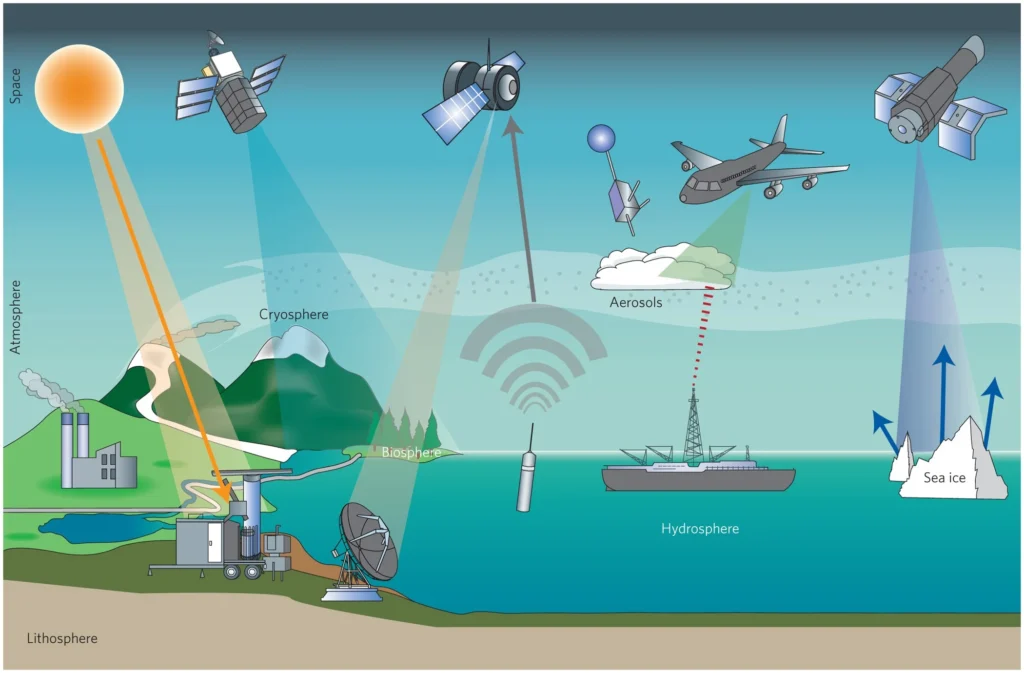
Along with ground-based IoT sensors and AI analytics, satellites are important for modern weather monitoring in smart cities.
They help smart cities track weather conditions more accurately. By providing wide observations, satellites support local ground data and give a broader view of the atmosphere. A full view is key to predict and prepare for major weather events.
Modern weather satellites have advanced, high-resolution sensors that capture data in many wavelengths.
From orbit, they track cloud formation, air pollution, temperature changes, and rainfall patterns. The collected data is added to global and local forecast models.
This greatly improves the accuracy of city-level weather predictions. For smart cities, these satellites act as early warning systems. They can spot storms or heatwaves early, often thousands of kilometers away.
When we combine satellite data with ground sensors in cities, we get a more detailed way to track weather. Satellites provide wide geographic coverage, while local sensors give detailed insights. Together, they help us understand weather systems better.
Additionally, satellite-based communications keep data moving smoothly between remote city sites. They work even when severe weather disrupts local infrastructure.
Small, low-cost CubeSats can fly in swarms. This is changing satellite technology by improving revisit rates and spatial coverage. These capabilities help smart city networks respond faster to changing weather patterns.
They also improve preparedness and resource allocation strategies. Consequently, satellite technology is vital to advanced weather monitoring systems that support smart city operations and resilience.
Building Climate Resilience with Weather Data and Adaptive Infrastructure
As climate change impacts grow more pronounced, smart cities focus on resilience and adaptive solutions to address these challenges. Weather monitoring systems give important data that helps design strong infrastructure. This helps it endure or adapt to extreme weather and changing climate conditions.
Real-time weather data and predictive analytics help urban planners and engineers. They make better choices about materials, drainage, and energy use. This matters when environmental conditions put systems under pressure.
For example, flood risk assessments based on past and recent rainfall can guide green infrastructure placement. These include rain gardens or permeable pavements. They help reduce flooding by soaking up extra water.
The idea of adaptive infrastructure is gaining attention, as structures use advanced sensors to monitor their condition.
These sensors check performance under different environmental stresses. They send real-time data to central management systems.
This innovation allows fast maintenance and extends the structure’s life while improving public safety. Similarly, weather-informed smart grids can adjust energy use in real time. They do this based on expected heating and cooling needs. This helps support climate mitigation efforts.
Moreover, weather data helps emergency response in smart cities. Automated alerts and data-based actions support fast evacuations during severe events. These events include hurricanes, heat waves, and air quality emergencies.
By adding full weather monitoring to urban resilience plans, cities can handle climate uncertainty and thrive amid environmental change.


Citizen Engagement and Public Health Impacts of Weather Monitoring
Integrating weather monitoring technologies into smart city infrastructure does more than improve services or governance. It also helps engage communities and protect public health. By giving accurate, local weather information, these systems help people, especially vulnerable groups.
They can make better choices each day. They can lower risks from extreme weather or environmental hazards.
Many smart cities now use public platforms like mobile apps and digital kiosks.
They provide real-time updates on weather, air quality, and temperature advisories. These resources help residents adjust plans for commuting, outdoor activities, or work, while reducing exposure to harmful conditions.
Additionally, weather data is vital for public health plans. It helps address heat illness, breathing problems, and disease outbreaks tied to climate changes. Advanced predictive analytics can spot high-risk times. This helps health authorities send timely warnings and deploy targeted actions.
For example, public alerts before heatwaves can support hydration campaigns and help set up cooling centers. This gives vital help to vulnerable people, such as older adults and those with existing health conditions.
Participatory sensing projects also increase citizen engagement. By asking residents to share personal weather observations on their devices, cities can improve data accuracy.
They can also increase data coverage and build shared awareness of environmental challenges. This shared approach raises awareness and supports community solutions. It also strengthens local ties in urban areas.
Bringing together weather insights, public health programs, and citizen engagement shows the wider role of smart cities.
As a result, technology is important. It helps build cities that include everyone. And it also makes cities more flexible and resilient. It helps protect safety and quality of life.
Weather monitoring is growing in smart cities. It combines IoT networks, AI analytics, satellite data, and community partnerships. Such innovations help cities respond to changing environmental conditions while supporting sustainability and safety.
As climate challenges grow, these systems must evolve and integrate more deeply. This will help cities build resilient urban ecosystems.
Moving forward, teamwork among tech developers, city planners, policymakers, and local communities will drive better weather monitoring solutions. By embedding adaptive climate intelligence in smart city systems, cities can meet today’s operational needs. They also build stronger defenses for a future they cannot predict.
The link between weather tracking and smart city planning will keep shaping future cities. This link will still matter. It will help guide how cities are designed in the future.