



Coverage of Weather Stations and Influencing Factors
I. Coverage of Weather Stations
The coverage of a weather station relies on a few key factors. These include the type of station, its design, the data it tracks, the weather conditions, and how many stations are nearby. Here is a detailed look at these aspects:
1. Varieties and Configurations of Weather Stations
– **Compact Handheld or Portable Weather Stations**: These devices are generally designed to cover a limited region. This area can range from tens to hundreds of square meters. They are often used for temporary or mobile weather monitoring tasks due to their portability and compact size.
– **Large Stationary Weather Stations**: These stations cover a wide area. Their reach can extend over several square kilometers or more. They are made for long-term weather monitoring and forecasting.
2. Monitoring Parameters
The specific factors measured by a weather station affect its coverage. Here is an analysis of some common factors:
– **Temperature and Humidity**
– *Temperature*: Temperature measurements can be affected by local conditions. They usually cover a range of a few to tens of meters.
– *Humidity*: Like temperature, humidity readings are greatly influenced by nearby environmental factors. They are effective within a range of a few to tens of meters.
– *Special Environments*: In underground places like mines, checking the temperature and humidity can be hard. This is due to factors like tunnel size, ventilation, and space limits.
– **Wind Speed and Direction**
– *Wind Speed*: The monitoring range depends on how high and where the anemometer is placed. Anemometers placed at higher points can measure wind speed over many meters or more.
– *Wind Direction*: Like wind speed, the range for monitoring direction depends on height and where it is installed. It usually covers tens of meters.
– *Complex Environments*: In areas with uneven ground or many buildings, checking wind accuracy can be difficult. This means we need more sensors to collect reliable data.
– **Precipitation**
– *Precipitation*: The effectiveness of rainfall measurement is often determined by the dimensions and placement of the rain gauge. Well-placed and sized rain gauges typically cover an area from a few meters to tens of meters.
– *Areas with High Precipitation*: Areas with a lot of rain may need larger rain gauges or better placement to collect accurate data.
– **Atmospheric Pressure**
– *Atmospheric Pressure*: The air pressure is steady. It is less affected by local changes in the environment compared to other factors. Its effective range is mostly limited to the exact location of the weather station.
– *Special Environments*: High mountains and deep-sea areas need special tools to measure pressure accurately in tough conditions.
3. Environmental Conditions
The surrounding environment plays a major role in defining the coverage of a weather station. The shape of the land, how thick the plants are, and where buildings are located can affect monitoring ability. Advanced technologies might be needed to make sure that stations give accurate data, even in tricky environments.
4. Deployment Density
The spatial resolution and accuracy of weather data improve when more devices are used in a specific area. Placing resources wisely and using them more widely helps improve coverage. This gives better and more continuous weather information for forecasts.
5. Coverage in Special Environments
Weather stations in special places like mines need to cover all important areas. This includes mining faces, back-mining sections, mining areas, and construction zones. This monitoring helps collect real-time weather data. It also provides important early warning systems to keep safety standards.
However, tough terrain or budget limits can make it hard to achieve the best deployment. Regular upgrades and improvements in station layout and management are important for solving these problems well.

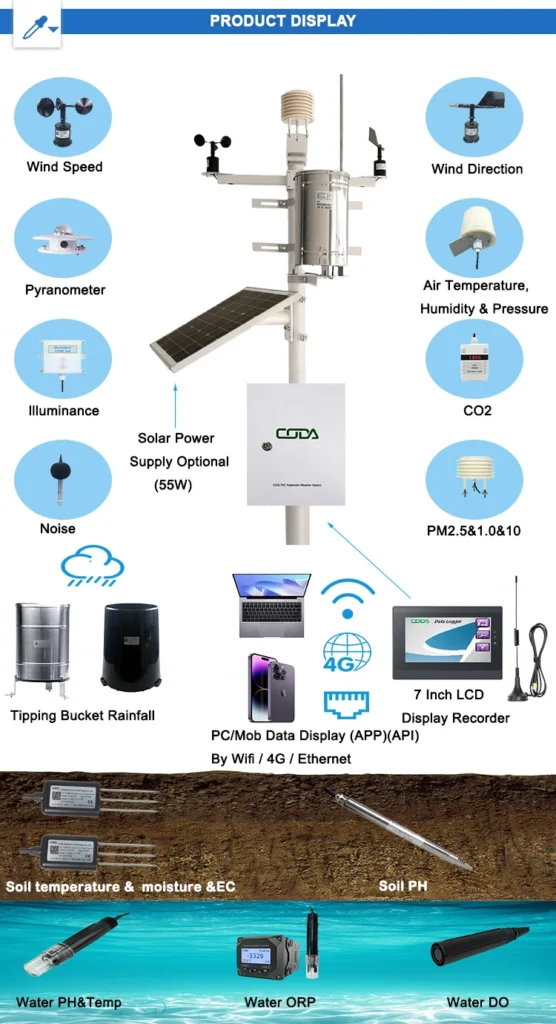
Weather stations observe many factors.
These factors help us understand weather patterns and climate changes. They also help us make accurate forecasts. Here is a summary of some common parameters that weather stations monitor:
1. **Temperature**
– **Definition**: Temperature is an important measure in weather science. It shows how hot or cold the air is.
– **Unit**: Measured in degrees Celsius (°C).
– **Significance**: Fluctuations in temperature have a direct impact on weather systems, climate trends, and ecosystems.
2. **Humidity**
– **Definition**: It shows how much water vapor is in the air. This impacts areas such as weather, farming, and the environment.
– **Unit**: Relative humidity is shown as a percentage (%).
– **Significance**: Changes in humidity impact how comfortable people feel, weather events, and climate changes.
3. **Barometric Pressure**
– **Definition**: It measures the force that the atmosphere pushes on a certain area.
– **Unit**: Typically recorded in hectopascals (hPa).
– **Significance**: Shifts in barometric pressure often signal changes in weather systems, including high- or low-pressure areas.
4. **Wind Speed**
– **Definition**: Denotes the rate at which air is moving.
– **Unit**: Measured in meters per second (m/s) or kilometers per hour (km/h).
– **Significance**: Changes in wind speed can affect weather patterns, air quality, and conditions in the atmosphere.
5. **Wind Direction**
– **Definition**: Shows the direction the wind comes from.
– **Unit**: Represented by geographic orientation (e.g., north, southeast) or angular degrees (°).
– **Significance**: Knowing wind direction is important for studying climate changes and following where air comes from.
6. **Precipitation**
– **Definition**: Describes rainfall or other forms of atmospheric water deposition that reach the ground.
– **Unit**: Measured in millimeters (mm).
– **Significance**: Precipitation data is critical for understanding weather patterns and managing water resources.
7. **Solar Radiation**
– **Definition**: Refers to electromagnetic energy transmitted from the sun to the Earth.
– **Unit**: Measured in watts per square meter (W/m²).
– **Significance**: Solar radiation is important for studying how plants make food, using renewable energy, and understanding climate.
8. **Visibility**
– **Definition**: The maximum distance at which an object can be discerned in the atmosphere.
– **Unit**: Expressed in meters (m) or kilometers (km).
– **Significance**: Visibility data is important for safety in transportation. This includes both aviation and marine industries.
9. **Soil Temperature**
– **Definition**: The heat level within soil layers.
– **Unit**: Measured in degrees Celsius (°C).
– **Significance**: It affects how plants grow, how microbes work in the soil, and how groundwater moves.
10. **Soil Moisture**
– **Definition**: Indicates the water content present in soil.
– **Unit**: Presented as a percentage by volume (%) or mass (%).
– **Significance**: Plays a vital role in plant hydration, irrigation practices, and erosion prevention.
11. **Evapotranspiration**
– **Definition**: It combines evaporation from surfaces with transpiration from plants into the air.
– **Unit**: Typically recorded in millimeters (mm).
– **Significance**: Evapotranspiration measurement aids in water resource planning and forecasting weather conditions.


The Principles for Deploying Meteorological Stations
Choosing the right place to install a weather station is important. This helps collect accurate and reliable weather data. The following considerations outline key factors for identifying an optimal site:
1. Representativeness
– **Definition**: The location should show the general climate of the area. It should not be affected by small, local climates.
– **Specific Requirements**: Pick a site with flat land. Avoid placing the station near hills, valleys, or buildings. These can change wind speed and rain measurements.
2. Terrain
– **Definition**: A flat area is best. Installations near hills or valleys can lower data quality.
– **Specific Requirements**: Make sure the area is clear of things like trees or buildings. These can block wind and sunlight.
3. Soil Type
– **Definition**: The soil’s traits affect measurements such as moisture and temperature.
– **Specific Requirements**: Choose a place with steady and reliable soil to prevent data errors.
4. Climatic Factors
– **Definition**: The chosen site must consider the weather. This includes strong winds, heavy rain, and extreme temperatures.
– **Specific Requirements**: Make sure the weather station can handle these tough conditions.
5. Accessibility
– **Definition**: The station should be in a spot that is easy to reach for regular maintenance and calibration tasks.
– **Specific Requirements**: Focus on locations that are easy to reach by public transport or cars for better service.
6. Security
– **Definition**: The chosen site should reduce risks from natural disasters and human interference.
– **Specific Requirements**: Stay away from places that may flood, slide, or have wildlife. Make sure the station is safe from vandalism or accidental damage.
7. Power Supply and Communication
– **Definition**: The station requires a reliable power source and stable communication network to transmit data seamlessly.
– **Specific Requirements**: Pick a place with reliable power and good communication signals. This will help keep operations running smoothly.
8. Surrounding Environment
– **Definition**: Limit outside pollution sources. These include heavy traffic, factories, or farming activities that might impact measurements.
– **Specific Requirements**: Choose a location away from pollution sources for better data collection.
9. Long-Term Stability
– **Definition**: The installation site should stay the same for the entire time the weather station is in use.
– **Specific Requirements**: Choose locations with clear land use patterns. This helps avoid problems from urban development or changes in land use.
Conclusion
In conclusion, picking the right spots for weather stations is a tricky job. It requires careful thought about local conditions. The stations check how well they cover areas and work effectively. So, when choosing a site, we should think about the environment, practical needs, and budget limits.
To improve the efficiency and reliability of monitoring, we must consider equipment type, placement, and density. These factors should be adjusted to fit the intended purpose. In the end, improving these parts helps weather stations provide accurate and useful data for their specific needs.