


Gauge Pressure, Absolute Pressure, and Vacuum Pressure
In our daily lives, we are always surrounded by atmospheric pressure, even if we don’t notice it. Atmospheric pressure is the weight of air around us. It is something we have learned to live with at the Earth’s surface.
Pressure is not seen or touched, but it is very important in daily tasks and industrial processes. From inflating tires to managing equipment in deep-sea exploration, precise pressure measurement is vital.
Different methods are used to measure pressure based on the application. These methods consider atmospheric pressure. This leads to three main types: gauge pressure, absolute pressure, and vacuum pressure.
Pressure is often seen as a simple force applied evenly over a surface. There are many types of pressure measurements. They all come from differential pressure. This pressure compares two reference points.
I have more than 15 years of experience. I create high-quality sensors. These sensors measure pressure, temperature, and humidity. I work at Coda.
As a senior product manager, I often answer questions about this topic. In this article, I will explain the main differences between gauge pressure, absolute pressure, and vacuum pressure. I will also show how they are related.
Definitions of Pressure Types
To understand different types of pressure, start by identifying the reference point for measurement.
1. Gauge Pressure: Measured Relative to Atmospheric Pressure
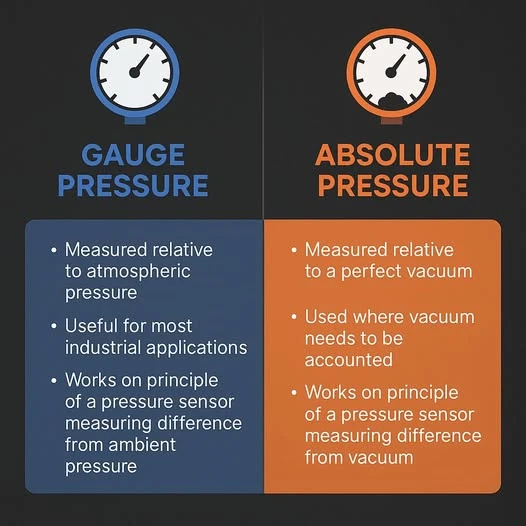
Gauge pressure is calculated by using atmospheric pressure as the reference point. This is considered the zero level. Since atmospheric pressure changes based on time and place, this starting point can differ. For example:
– At higher altitudes, there is less air above the surface. This causes the atmospheric pressure to decrease.
– In lower-altitude areas, the air pressure increases..
These changes mean that gauge pressure readings are affected by altitude and weather. Gauge pressure can be either positive or negative. Positive pressure is above atmospheric pressure. Negative pressure is lower than atmospheric pressure. It is often called a vacuum level.
Many industries use equipment in normal air conditions. So, gauge pressure is the standard measurement in these cases. It makes it easy to check a few things. You can find out if a boiler has too much pressure. You can also see if a tire is inflated correctly.
Additionally, you can check if a pump’s discharge pressure is stable. All this can be done without needing the exact absolute pressure value. Gauge pressure is very helpful for making clear and practical decisions in industrial settings.
2. Absolute Pressure: Measured Relative to a Theoretical Vacuum
Absolute pressure refers to a perfect state of zero pressure. This is called a perfect vacuum. In this state, all gas is completely removed from an area.
This idea offers a standard for measurement that everyone can use. However, creating a perfect vacuum is nearly impossible. Even space does not fully meet this standard. A zero-level absolute vacuum is a concept used mainly in physics and engineering models.
Absolute pressure plays a critical role in advanced scientific and industrial applications. For example:
Gas behavior is described by state equations. This behavior depends on the physical forces that gas molecules feel. These forces are directly related to absolute pressure values.
– Fields like making semiconductors, analyzing gas density, and experimental sciences depend on absolute pressure. This is important for accurate calculations and useful results.
3.Vacuum pressure is any pressure that is lower than normal air pressure.
When the pressure drops below atmospheric levels, it enters the vacuum pressure range. This type of pressure is defined in relation to atmospheric pressure. It acts in a downward direction, making it a form of negative pressure.
Vacuum pressure can be shown in two main ways. First, it is often called negative pressure. For example, -0.06 MPa means the chamber pressure is 0.06 MPa lower than atmospheric pressure.
This is called gauge vacuum pressure. Second, it can be shown as an absolute vacuum level. For example, 25 kPa abs means the pressure is 25 kPa above a complete vacuum.

The Connection Among Gauge, Absolute, and Vacuum Pressures
The link between these types of pressure is clear and shows how they depend on each other. They are linked in the following manner:
Absolute Pressure = Atmospheric Pressure + Gauge Pressure
Vacuum Pressure = Atmospheric Pressure minus Absolute Pressure
Vacuum pressure is found by taking atmospheric pressure and subtracting absolute pressure from it. For instance, with an absolute pressure of 30 kPa and an atmospheric pressure of 100 kPa, the vacuum pressure would be 70 kPa.
Gauge Pressure equals the negative of Vacuum Pressure
A vacuum level can be seen as the negative value of gauge pressure. When the vacuum level hits 40 kPa, the gauge pressure shows -40 kPa. This means the system works at a pressure 40 kPa lower than the air pressure.
Gauge pressure shows if the system works above or below atmospheric levels. A positive gauge pressure means the system is above atmospheric pressure. A negative gauge pressure shows a vacuum state. Knowing this principle helps you make accurate pressure conversions.
Industrial Pressure: Why the Distinction Matters
It is important to understand the differences between absolute pressure, gauge pressure, and vacuum pressure. Each type uses specific reference points and has different uses in engineering.
Absolute pressure shows basic physics principles. Gauge pressure measures the effective force for engineering. Vacuum pressure explains the level of underpressure in low-pressure systems.
It’s important to know that pressure is not just a single value. It is a physical quantity linked to a specific reference point. Confusing these definitions can cause errors in calculations, equipment overpressure, misinterpreted instrument readings, or even safety hazards.
1. Applications in Different Contexts
Gauge pressure uses the local atmospheric pressure as its starting point. It shows how a system’s pressure compares to the pressure around it. In factories, gauge pressure is often shown on equipment. This includes pressure gauges that check steam pipeline conditions.
Absolute pressure, on the other hand, measures relative to a perfect vacuum as its zero baseline. It shows a true measurement of pressure that does not change with the atmosphere. This is important for thermodynamic calculations, like analyzing steam states. Accurate pressure readings affect energy transfer and efficiency assessments.
Vacuum pressure deals with conditions below normal air pressure. It is important in systems like condensers and vacuum pumps. Their performance depends on the difference between absolute and atmospheric pressures.
2. Mechanical Safety Considerations
In places with negative pressure, like boiler draft systems or vacuum-sealed packaging, managing that pressure is important. This helps keep flue gas contained and maintains product quality. Mistaking negative gauge pressure for vacuum pressure can lead to underestimating vacuum strength. This can put safety and efficiency at risk.
Excessive back pressure can reduce turbine efficiency. To monitor it effectively, you must correctly identify the type of pressure used. Mislabeling these can overload equipment or waste energy.
3. Selecting Suitable Measuring Instruments
Different applications need different types of pressure readings and the tools to measure them. Gauge pressure devices use atmospheric pressure as their reference point. Absolute pressure instruments use a vacuum as their base. Vacuum gauges also compare against atmospheric pressure.
To ensure the best performance, it is important to clearly identify these types of pressure. This helps in choosing the right measuring tool.
4. Adhering to Safety Standards
Codes for pressure vessels and pipelines often state if the design should use gauge or absolute pressure. Mixing up these standards can lead to designs that do not comply. This can create issues during inspections or audits and may cause legal problems.
For processes that use vacuum or low-pressure systems, using gauge pressure instead of vacuum data can cause problems. This mistake can lead to unsafe practices and increased risks. It is important to understand and follow these differences. This helps keep us compliant and reduces risks in operations.

Which Devices Are Utilized for Measuring Pressure?
1. Analog Pressure Gauge
Mechanical pressure gauges are some of the oldest and most common tools for measuring pressure. They work by changing pressure changes into pointer movements using mechanical parts.
Bourdon tube pressure gauges work by bending a metal tube when pressure is applied. This bending moves a pointer through a lever and gear system.
Capsule pressure gauges use diaphragm bending to move the pointer. This makes them good for measuring low or changing pressures. Diaphragm pressure gauges work in a similar way.
They use a diaphragm to transfer the pressure of the medium to a spring or pointer system. These gauges are appreciated for their simple and strong design. This makes them great for direct readings on-site.
2. Pressure Sensor
Pressure sensors change when pressure affects their resistance, capacitance, inductance, or piezoelectric properties. They turn these changes into standard electrical signals. These signals can then be processed to give digital readings.
Pressure sensors come in various types, such as piezoresistive, strain gauge, capacitive, piezoelectric, and fiber optic. These devices help monitor pressure continuously. They also support functions like remote data collection and automation in control systems.
3. Vacuum Gauge
Vacuum gauges are made to measure pressure levels that are lower than atmospheric pressure. This is known as vacuum pressure. These instruments measure many vacuum levels. They can work from near atmospheric conditions to ultra-high vacuum levels of about 10⁻⁹ Pa.
Their high sensitivity and special design help them give accurate readings in low-pressure situations. This makes them important for precise process control and vacuum level analysis.
4. Differential Pressure Sensor
Differential pressure sensors are used to measure the pressure difference between two places. They do not measure absolute pressure levels. They are often used for monitoring liquid levels, finding filter blockages, and checking pressure differences in duct systems.
These sensors give direct readings of the pressure difference. This allows for continuous monitoring and automated control without manual conversions.